




National Park · Northeastern Thailand
Phu Wiang National Park
อุทยานแห่งชาติภูเวียง
Where Thailand’s dinosaur story comes alive
Khon Kaen · Isan · Northeastern Thailand
Walk through a living forest, stand beside genuine dinosaur excavation sites and read more than 100 million years of Earth history in the rocks.
Where Thailand’s Dinosaur Story Comes Alive
Long before Thailand had cities, highways or rice fields, the landscape around Phu Wiang was home to dinosaurs.
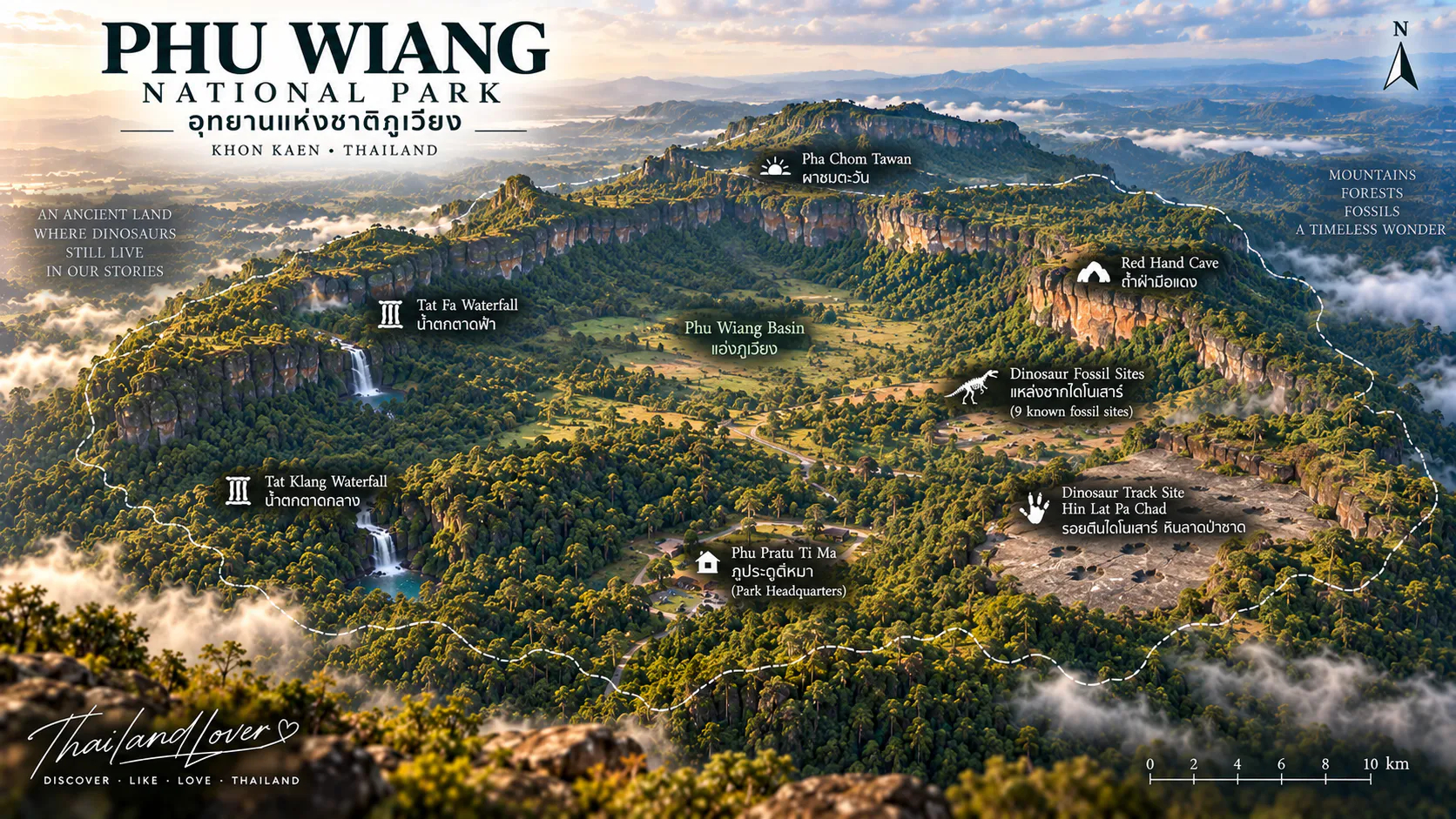
Today, Phu Wiang National Park is one of Thailand’s most important places for understanding the country’s prehistoric landscape. Its mountains form a remarkable ring around the Phu Wiang Basin, while sandstone cliffs, dry forests, waterfalls, rock platforms and fossil sites create a landscape where geology and nature are inseparable.
But Phu Wiang is not simply a “dinosaur park.” Here you can walk through a living forest, stand beside genuine excavation sites, look across ancient rock formations and begin to understand what northeastern Thailand looked like more than 100 million years ago.
For travellers interested in dinosaurs, geology, nature, photography or places beyond Thailand’s usual tourist circuit, Phu Wiang reveals a very different side of Isan.
Phu Wiang at a Glance
- Location
- Khon Kaen Province, Northeastern Thailand
- Districts
- Phu Wiang, Wiang Kao, Si Chomphu and Chum Phae areas
- Area
- Approximately 325 km²
- Highest Point
- Approximately 844 m above sea level
- Landscape
- Mountain ranges surrounding an interior basin
- Famous For
- Dinosaur fossils and trace fossils
- Established
- 1991
- Status
- Thailand’s 71st national park
- Iconic Dinosaur
- Phuwiangosaurus sirindhornae
- Main Experience
- Excavation sites, forest, geology and waterfalls
Department of National Parks information describes Phu Wiang as a double-ring mountain system surrounding a large interior basin. The outer range reaches about 844 metres, while the inner range rises to about 470 metres and contains important dinosaur fossil areas.
Why Visit Phu Wiang?
Phu Wiang is unusual because the landscape itself tells the story. You are not simply looking at dinosaur skeletons inside a museum; the fossils were discovered in the geological formations around the basin.
The experience is closer to walking through an open-air geological archive.
- Dinosaur excavation sites
- Ancient sandstone landscapes
- Dry dipterocarp and mixed deciduous forests
- Waterfalls and seasonal streams
- Rock platforms and cliffs
- Geological interpretation
- Hiking, birdwatching and wildlife
- Prehistoric and cultural heritage
The Story of the Dinosaurs
The modern dinosaur story of Phu Wiang began in 1976, when geological exploration led to the discovery of a dinosaur bone. That find transformed the scientific importance of the region.
Further work revealed numerous sites containing bones, teeth and associated prehistoric remains, as well as trace fossils. The animals lived during the Mesozoic Era, when the landscape and climate of present-day northeastern Thailand were dramatically different.
Phuwiangosaurus sirindhornae
One of Phu Wiang’s most famous discoveries is Phuwiangosaurus sirindhornae, a long-necked herbivorous sauropod identified as a new genus and species. Its name honours Her Royal Highness Princess Maha Chakri Sirindhorn.
At Excavation Site 1 on Phu Pratu Ti Ma, researchers found remains of this large herbivore together with teeth attributed to carnivorous dinosaurs. Department of Mineral Resources records connect the site with both Phuwiangosaurus sirindhornae and Siamosaurus suteethorni.
Think of the evidence less as one dinosaur skeleton and more as a snapshot of an ancient ecosystem.
Other Dinosaurs of Phu Wiang
- Siamosaurus suteethorni
- A carnivorous dinosaur known particularly from distinctive, crocodile-like teeth and associated feeding adaptations.
- Siamotyrannus isanensis
- A large theropod whose remains add important evidence to the evolutionary history and diversity of carnivorous dinosaurs in ancient Asia.
- Kinnareemimus khonkaenensis
- An ostrich-like theropod associated with the wider dinosaur discoveries of the Khon Kaen region and its “Dinosaur Land” story.
The Dinosaur Excavation Sites
Phu Wiang’s dinosaur story is spread across multiple excavation localities, not concentrated in a single attraction. Together, bones, teeth, footprints and other traces reveal an ancient ecosystem.
- Site 1 · Phu Pratu Ti Ma
- One of the best-known localities, associated with Phuwiangosaurus sirindhornae and Siamosaurus suteethorni.
- Site 4 · Non Sao E
- Produced Phuwiangosaurus remains together with fish scales and turtle shell material, offering clues to the wider environment.
- Site 5 · Sum Ya Kha
- Associated with juvenile Phuwiangosaurus remains, valuable for understanding dinosaur growth and development.
- Site 8 · Hin Lat Pa Chad
- A trace-fossil locality with small theropod tracks, bird tracks, claw-drag marks and other prehistoric evidence.
- Site 9 · Hin Lat Yao
- Associated with the large theropod Siamotyrannus isanensis.
A Landscape Built Around a Basin
The geography of Phu Wiang is almost as fascinating as its fossils. Two major mountain rings surround a lower central basin. The outer system reaches approximately 844 metres; the inner system rises to about 470 metres.
Rather than one continuous mountain wall, visitors encounter ridges, slopes, sandstone formations, forest and open areas surrounding the basin — a structure that gives Phu Wiang its distinctive character.
Forests & Wildlife
Dinosaurs may be the headline, but modern Phu Wiang is also a protected forest ecosystem.
- Dry evergreen forest
- Dry dipterocarp forest
- Mixed deciduous forest
- Rocky and open woodland
These habitats support birds, reptiles, small mammals and other wildlife typical of northeastern Thailand. Sightings are a bonus, not a guarantee. Early morning usually offers cooler temperatures and more activity; bring binoculars if birdwatching matters to you.
Waterfalls & Seasonal Nature
Phu Wiang’s waterfalls become especially attractive during and after the rainy season. Treat them as seasonal nature attractions rather than guaranteed year-round swimming destinations.
- Tat Fa Waterfall
- One of the park’s better-known natural attractions, dropping through a forested landscape and becoming more dramatic when water levels rise.
- Tat Klang Waterfall
- Located farther inside the park area; access can change with season and local management.
- Thap Phaya Suea Waterfall
- A smaller waterfall associated with the forest around the prehistoric sites.
Red Hand Cave & Ancient Human Traces
Red Hand Cave — Tham Fa Mue Daeng adds an archaeological chapter to Phu Wiang. Red hand imagery was created by placing a hand against the rock and applying pigment around it, leaving an outline.
Dinosaurs lived here millions of years ago. Much later, prehistoric humans also left their mark. Never touch, trace, wet or otherwise interfere with the fragile rock art.
More Than Dinosaurs: Geological Phu Wiang
The park lies on the Khorat Plateau, where thick sedimentary sequences record ancient environments. Regional geology includes the Phu Kradung, Phra Wihan, Sao Khua, Phu Phan and Khok Kruat formations.
These rocks helped preserve the fossils. For geology-minded travellers, Phu Wiang offers the rare chance to connect the visible landscape with the scientific story beneath it.
Phu Wiang Dinosaur Museum
The Phu Wiang Fossil Research Centre and Dinosaur Museum is an excellent companion to the national park. Importantly, it sits outside the park, in the lower area before the entrance.
- Formation of the Earth
- Rocks, minerals and fossils
- Dinosaur discoveries
- Evolution of life
- Dinosaur reconstructions
- Geological history of Khon Kaen
How to Experience Phu Wiang
Phu Wiang works best as a half-day to full-day nature and science experience.
- The Dinosaur Explorer
- Museum → Excavation Site 1 → other accessible sites → viewpoints and forest → waterfall. Best for a first visit.
- Nature + Dinosaurs
- Start early with a forest walk, continue to the dinosaur sites, rest at midday and finish with a waterfall or late-afternoon photography.
- Family Learning Trip
- Combine the museum, accessible excavation sites and a simple nature walk for an engaging educational day.
When to Visit
- November–February
- Generally the most comfortable period. Cooler mornings make walking and sightseeing more pleasant.
- March–May
- Hotter and drier. Start early because midday hiking can become uncomfortable.
- May–October
- Greener scenery and potentially stronger waterfalls, but rain can affect roads, trails and access.
Always check current conditions, particularly during heavy rain, wildfire-risk periods or temporary management closures.
Photography Guide
- Early Morning
- Best for soft forest light, wildlife, quiet fossil sites and mist after rain.
- Midday
- Strong light can reveal sandstone formations, geological textures and excavation structures.
- Late Afternoon
- Look for mountain silhouettes, warm sandstone tones and layered landscapes.
- A Different Dinosaur Photograph
- Frame rock → fossil site → forest → mountain. It tells Phu Wiang’s story better than sculptures alone.
Getting There
Phu Wiang National Park is approximately 85–90 kilometres west of Khon Kaen city. The usual route follows Highway 12 toward Chum Phae, then connects toward Phu Wiang via Highway 2038.
Allow roughly 1.5–2 hours by car, depending on your exact destination and road conditions. A private or rental car is the most practical option; arranged local transport also makes it easier to move between the museum, fossil sites and natural attractions.
Where to Stay
- Khon Kaen City
- Best for hotels, restaurants, cafés, transport connections and combining Phu Wiang with other attractions.
- Phu Wiang Area
- Better for a quieter rural atmosphere, an early start and more time around the park.
- Inside the Park
- Accommodation and camping may be available, but operating conditions vary. Confirm directly before relying on them.
What to Bring
- Comfortable walking shoes
- Sun protection and a hat
- Insect repellent
- Drinking water
- Lightweight long sleeves
- Camera and power bank
- Binoculars
- Wet-season rain protection
For longer trails or less accessible fossil localities, follow park staff instructions and prepare accordingly.
Important Visitor Etiquette
Phu Wiang contains scientifically important fossil and archaeological resources. Do not collect rocks, fossils, fossil fragments or other natural materials.
Do not touch excavation surfaces, remove material or alter prehistoric rock art. Stay on designated paths. The scientific value of a fossil depends partly on its original geological context — leave that evidence intact for future research.
Phu Wiang for Families
Phu Wiang is one of Thailand’s most naturally educational national-park experiences. A child encounters the subject in three memorable stages: Museum → Real excavation site → Real landscape.
Invite younger visitors to become dinosaur detectives: what did the animal eat, did it walk on two legs or four, why were its footprints preserved and what can one tooth reveal? The landscape becomes the classroom.
Phu Wiang for International Travellers
If you have already visited Bangkok, Chiang Mai, Phuket and the major beaches, Phu Wiang offers a completely different Thailand. This is not a destination built around nightlife or luxury resorts; it is about deep time, geology, science and landscape.
Build a wider Khon Kaen itinerary around the city, local Isan food, the dinosaur museum, Ubolratana and other geological attractions in the province.
Essential Information
- Destination
- Phu Wiang National Park
- Thai
- อุทยานแห่งชาติภูเวียง
- Province
- Khon Kaen
- Region
- Northeastern Thailand / Isan
- Area
- Approximately 325 km²
- Established
- 1991 · Thailand’s 71st national park
- Highest Elevation
- Approximately 844 m
- Main Attraction
- Dinosaur fossil and trace-fossil sites
- Best For
- Dinosaurs, geology, families, nature, photography and educational travel
- Recommended Time
- Half day to full day
- Transport
- Private car or rental car recommended
Frequently Asked Questions
- Where is Phu Wiang National Park?
- In Khon Kaen Province, roughly 85–90 kilometres west of Khon Kaen city in northeastern Thailand.
- What is Phu Wiang famous for?
- Genuine dinosaur fossil and trace-fossil localities, especially discoveries linked with Phuwiangosaurus sirindhornae.
- How much time should I allow?
- At least half a day; a full day is better for the museum, excavation sites, forest and a seasonal waterfall.
- Should I visit the museum first?
- Yes. The museum gives you the scientific context needed to understand the real landscape and excavation sites.
Location
Find Phu Wiang National Park
Phu Wiang · Khon Kaen · Northeastern Thailand