

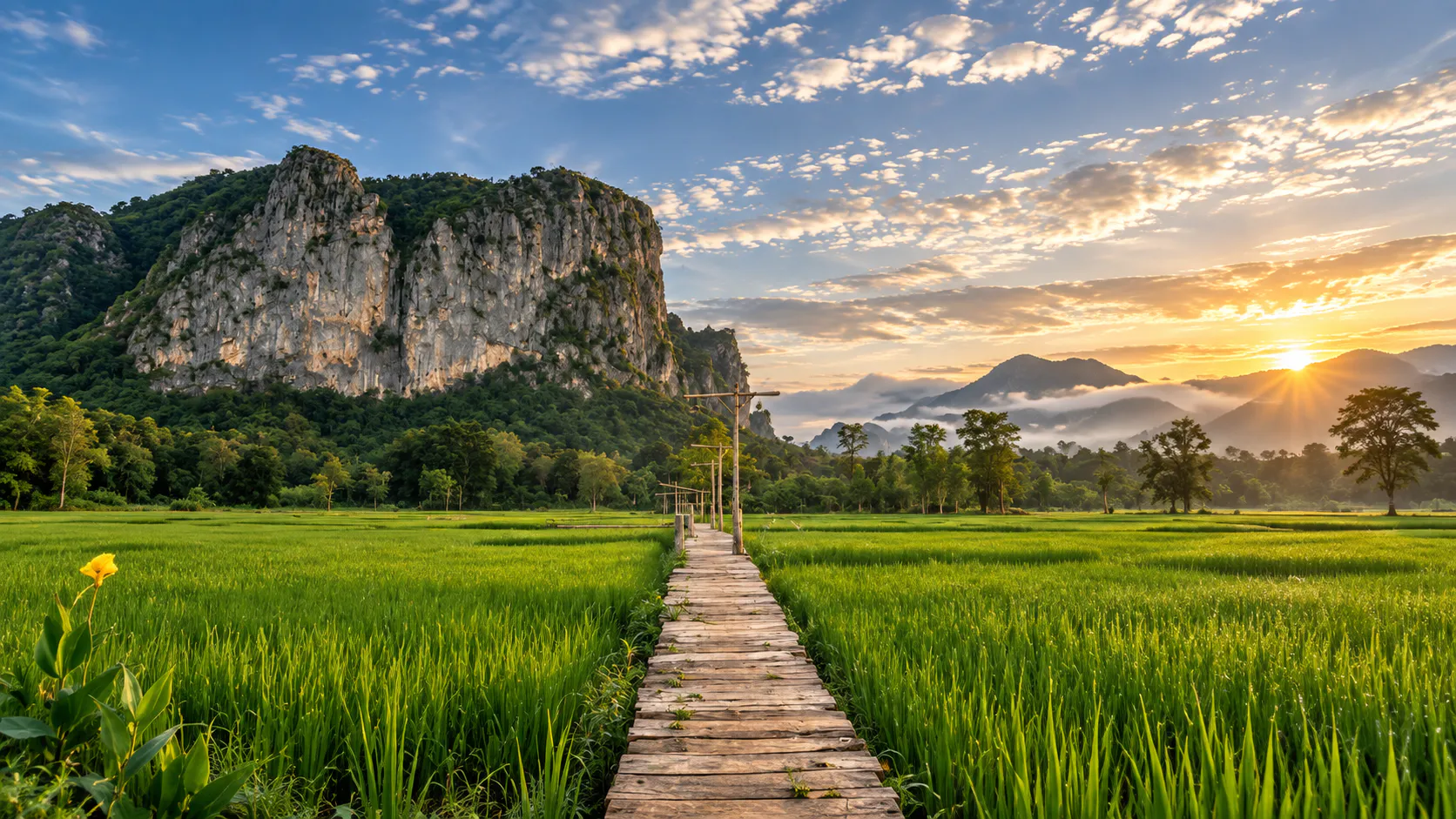
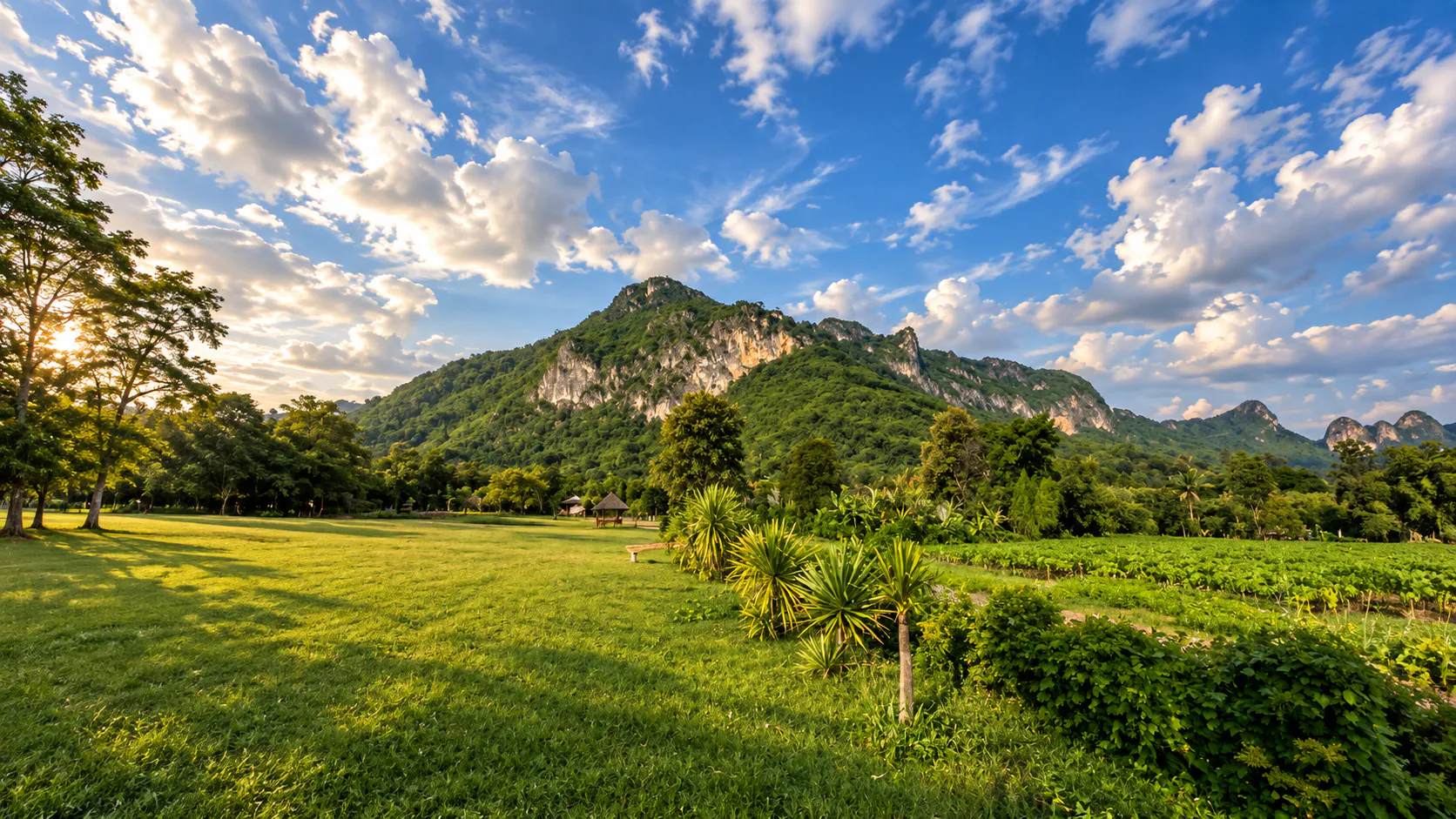
National Park · Limestone Karst · Isan
Phu Pha Man National Park
อุทยานแห่งชาติภูผาม่าน
Limestone Cliffs, Caves, Waterfalls & the Evening Flight of Millions of Bats
Khon Kaen & Loei · Northeastern Thailand
A dramatic landscape where monumental cliffs rise above farms and forest, water carves hidden caves, and a vast ribbon of bats moves across the evening sky.
Where Rock, Water, Wildlife & People Meet
Phu Pha Man begins with a wall of limestone, but the cliffs are only the entrance to a much deeper story.
Inside the mountains are stalactite-filled caves, underground passages and ancient paintings. Forest streams descend toward seasonal waterfalls, while local fields spread beneath steep rock faces that resemble a giant hanging curtain.
Then, at dusk, Tham Khang Khao comes alive. A huge bat colony leaves the cliff in a long, moving ribbon — one of northeastern Thailand’s most memorable natural spectacles.
Stone → Cave → Forest → Water → Wildlife → People
At a Glance
- Official Name
- Phu Pha Man National Park
- Thai Name
- อุทยานแห่งชาติภูผาม่าน
- Region
- Northeastern Thailand · Isan
- Provinces
- Khon Kaen and Loei
- National Park Number
- 72
- Established
- 8 December 1991
- Area
- Approximately 218,750 rai / 350 km²
- Elevation
- Approximately 200–800 metres
- Landscape
- Limestone mountains, cliffs, caves, forest, streams and waterfalls
- Best For
- Bat watching, caves, geology, waterfalls, hiking and photography
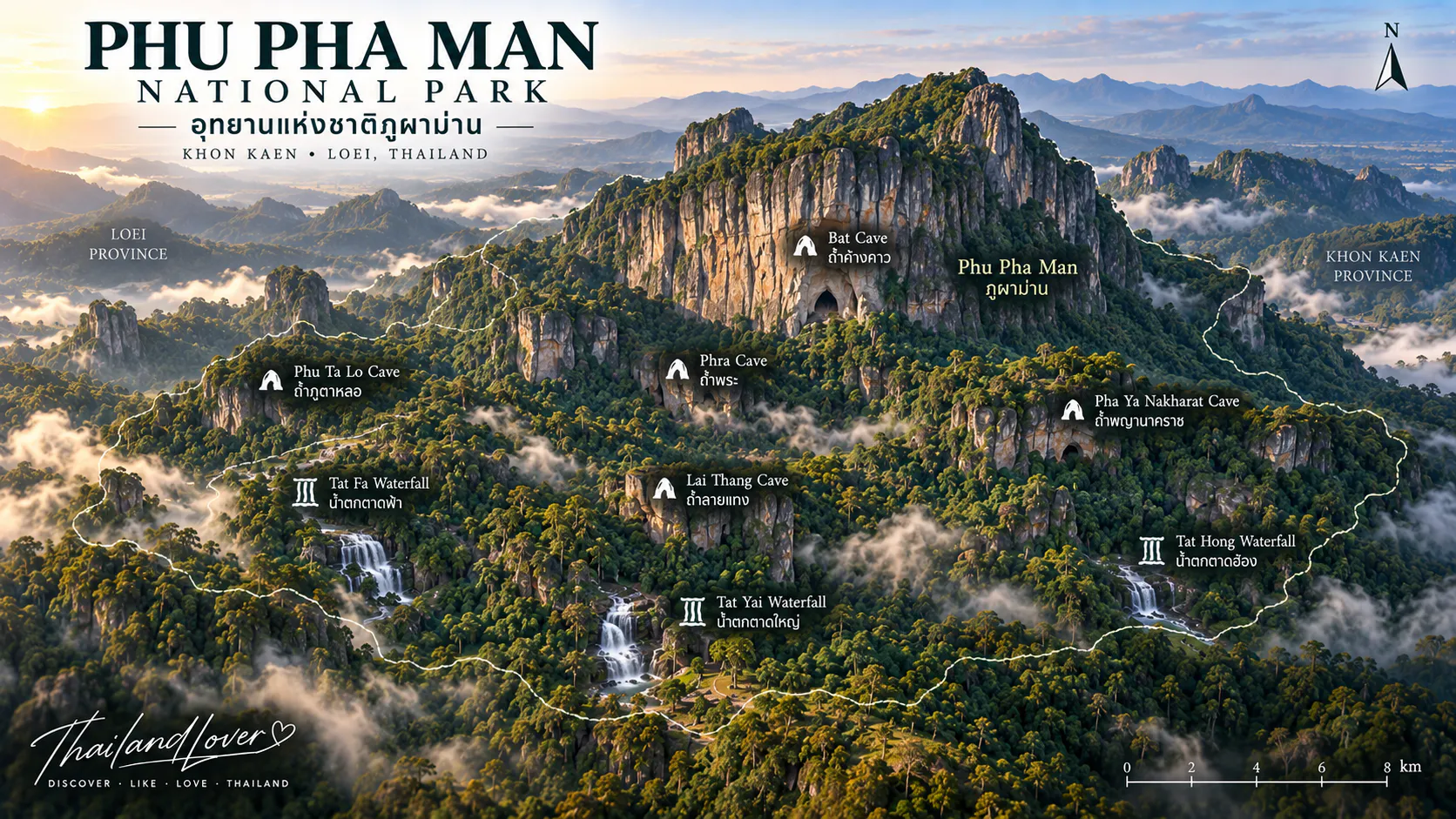
The park covers parts of Chum Phae and Phu Pha Man districts in Khon Kaen, plus Phu Kradueng District in Loei. Headquarters is in the Dong Lan forest area of Na Nong Thum, Chum Phae.
Why Visit Phu Pha Man?
Few Isan landscapes combine so many layers within one journey. Here, the scenery above ground and the hidden world below it are inseparable.
- Watch a vast bat colony emerge at dusk
- Stand beneath monumental limestone walls
- Explore caves sculpted by water
- See prehistoric paintings at Lai Thaeng Cave
- Visit seasonal forest waterfalls
- Photograph mountains rising directly from farmland
The Curtain Mountain
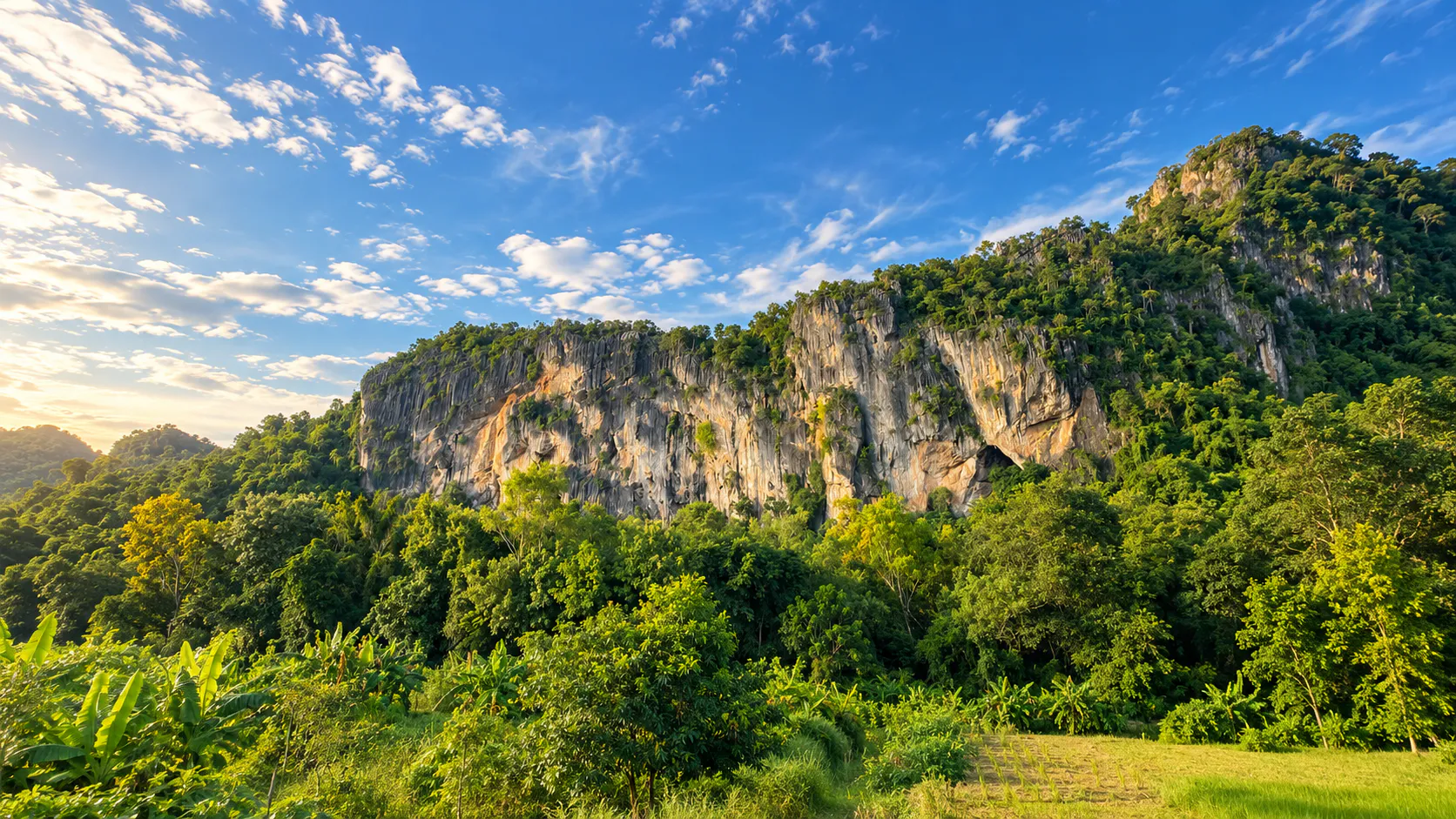
The park’s identity comes from its long, steep limestone wall. Seen from the agricultural lowlands, the vertical face and ridgeline resemble a vast curtain — the image behind the name Phu Pha Man.
Late-afternoon light reveals fissures, ledges and folds in the rock, while fields and trees in the foreground show the immense scale of the cliff.
Water, the Architect
Rainwater becomes mildly acidic as it passes through air and soil. Entering tiny cracks, it slowly dissolves limestone and enlarges the openings over thousands of years. This karst process creates caves, sinkholes, underground channels, chambers, stalactites and stalagmites.
Caves → Streams → Waterfalls → Forest
Forest & Wildlife
- Dry Evergreen Forest
- Denser, cooler forest persists around moist valleys, streams and cave environments, providing important wildlife habitat.
- Mixed Deciduous Forest
- Drier slopes open as trees shed leaves in the dry season, then turn rapidly green when the rains return.
- Limestone Habitats
- Exposed rock, cliff ledges and cave entrances create specialized conditions for orchids, ferns, vines and other native plants.
Wild boar, barking deer, muntjac, pangolins, monitor lizards, squirrels, small carnivores, birds and bats are associated with the park. Sightings are never guaranteed; quiet early-morning walks offer the best chance to notice forest life.
Tham Khang Khao · The Bat Cave
Tham Khang Khao is Phu Pha Man’s signature wildlife experience. Its entrance sits high in a limestone cliff, where a very large colony of bats roosts during the day.
At dusk, a few bats appear first. Within minutes, the flow becomes a continuous stream that twists, expands and contracts across the sky. The main emergence is often reported to last around 30–45 minutes, though weather, season and daylight affect both timing and appearance.
The bats are beginning their nightly feeding cycle, not performing for visitors. Insect-eating species also play an important role in regulating insect populations.
Caves Beneath the Mountain
- Phaya Nakarat Cave
- A geological journey through stalactites, stalagmites, flowstone, rock curtains, narrow passages and larger chambers. Its winding form is compared with the body of a naga.
- Lai Thaeng Cave
- An archaeological site with human, animal and symbolic paintings. Local descriptions identify around 70 images, some commonly dated to approximately 2,000 years ago.
- Phra Cave
- A limestone cave with local cultural associations; current access should be confirmed with park staff.
- Phu Ta Lo Cave
- Another window into the park’s underground landscape, where daylight and forest give way to darkness, water and stone.
Waterfalls of Phu Pha Man
- Tat Fa Waterfall
- A five-level waterfall fed by Huai Tat Fa. Its final stage is reported to drop around 80 metres and requires a genuine nature excursion rather than a quick roadside stop.
- Tat Rong · Tat Hong
- A waterfall near the meeting point of the Phu Pha Man and Phu Kradueng landscapes in Loei, with a drop commonly reported at roughly 60–70 metres.
- Tat Yai Waterfall
- Another major seasonal fall, reported at approximately 80 metres and most impressive after sustained rainfall.
Waterfall conditions change dramatically. The rainy season brings the greatest flow, while smaller falls may weaken or nearly disappear after prolonged dry weather.
Rivers & Watersheds
The limestone mountains are also a source of water. Streams including Huai Phu Hi, Huai Chomphu, Huai Kha Hao, Huai Yang and Huai Sam Khaen descend from the park and connect with larger systems such as the Nam Phong and Nam Choen.
Protecting the mountain forest therefore matters far beyond the park boundary: it supports water, farms and communities across the surrounding lowlands.
Climate & Best Time to Visit
- Cool season · November–February
- The most comfortable period for hiking, cave visits and outdoor exploration. Clear mornings can feel cool near the mountains.
- Hot season · March–May
- Plan active outings for early morning and late afternoon, carry water and avoid exposed walks during peak heat.
- Rainy season · June–October
- The forest turns intensely green and waterfalls strengthen, but cave floors, trails and limestone become slippery.
- Bat watching: suitable evenings year-round
- Waterfalls: rainy season
- Hiking: cool season
- Photography: early morning and late afternoon
Plan Your Experience
One Day
- Morning
- Begin with an officially accessible cave or a quiet nature attraction while temperatures are comfortable.
- Midday
- Rest through the hottest hours and confirm evening bat conditions locally.
- Afternoon
- Choose a forest or waterfall visit according to season, weather and access.
- Before Sunset
- Reach the Bat Cave viewing area early, find a safe position and stay for the full emergence.
Two Days
Use day one for Phaya Nakarat Cave, Lai Thaeng’s rock art and the Bat Cave. On day two, choose an accessible seasonal waterfall, forest walk, Pha Nok Khao landscape or time with nearby communities.
Underground Thailand + Above-ground Thailand
Photography Guide
- Limestone Cliffs
- Photograph from a distance and include fields, trees or people to communicate the cliffs’ scale.
- Bat Flight
- Use a fast shutter for individual bats or a wide composition to show the moving ribbon. Never direct strong light toward the cave.
- Caves
- Use tripods only where permitted and never brace equipment against fragile formations.
- Waterfalls
- Long exposures can show movement, but no photograph is worth standing on unsafe, slippery rock.
Cave & Waterfall Safety
- Confirm that the cave or trail is officially open
- Use a guide where required and carry reliable lighting
- Never enter an unfamiliar cave alone
- Avoid caves during dangerous weather or heavy rain
- Treat wet limestone and stream rocks as extremely slippery
- Never cross fast water or swim in unfamiliar pools
- Follow signs, barriers and ranger instructions
- Check current conditions before every excursion
Travel Responsibly
Phu Pha Man protects geological, archaeological and living resources that cannot be replaced.
- Do not collect limestone, fossils or natural objects
- Never touch cave formations or rock paintings
- Do not feed, chase or approach wildlife
- Keep flash and artificial light away from bats
- Carry all rubbish out of the park
- Keep voices low in caves and wildlife areas
Frequently Asked Questions
- Where is Phu Pha Man National Park?
- It covers parts of Khon Kaen and Loei provinces in northeastern Thailand, with the main visitor area associated with Phu Pha Man and Chum Phae.
- Why is it called Phu Pha Man?
- The name is associated with the steep limestone wall, whose long vertical form resembles a large hanging curtain.
- What is the park famous for?
- Limestone cliffs, caves, waterfalls, prehistoric paintings and the enormous evening bat emergence from Tham Khang Khao.
- How long does the bat flight last?
- Around 30–45 minutes is commonly reported, although timing, duration and visibility vary with natural conditions.
- Can visitors enter the Bat Cave?
- The experience is watching the colony from outside. Follow current park rules and never enter or disturb the roost.
- What is Lai Thaeng Cave?
- A cave with ancient paintings of human, animal and symbolic forms — an important archaeological feature of the park.
- When are the waterfalls best?
- The rainy season generally brings the strongest flow, together with slippery rocks and faster currents.
- Is the park suitable for families?
- The outdoor Bat Cave viewing experience can suit families; demanding cave and waterfall routes require more preparation and caution.
- How long should I stay?
- One day covers a principal nature activity and the Bat Cave. Two days gives better time for caves, waterfalls and forest.
- Is Phu Pha Man the same as Phu Kradueng?
- No. They are separate national parks, although Phu Pha Man extends into Phu Kradueng District and the protected landscapes are close.
- Is Phu Pha Man the same as Phu Pha Lek?
- No. Phu Pha Lek is a different national park in the Phu Phan mountain range.
Location
Find Phu Pha Man National Park
Chum Phae & Phu Pha Man · Khon Kaen · Northeastern Thailand