



National Park · Kanchanaburi
Erawan National Park
อุทยานแห่งชาติเอราวัณ
Seven Falls, Limestone Mountains & the Emerald Heart of Western Thailand
Kanchanaburi · Western Thailand
A seven-tiered limestone waterfall of emerald pools, forest paths and mountain streams — the most accessible expression of a much larger protected landscape.
The Emerald Heart of Western Thailand
There are waterfalls you visit for the view.
And then there are places where the landscape itself becomes the experience.
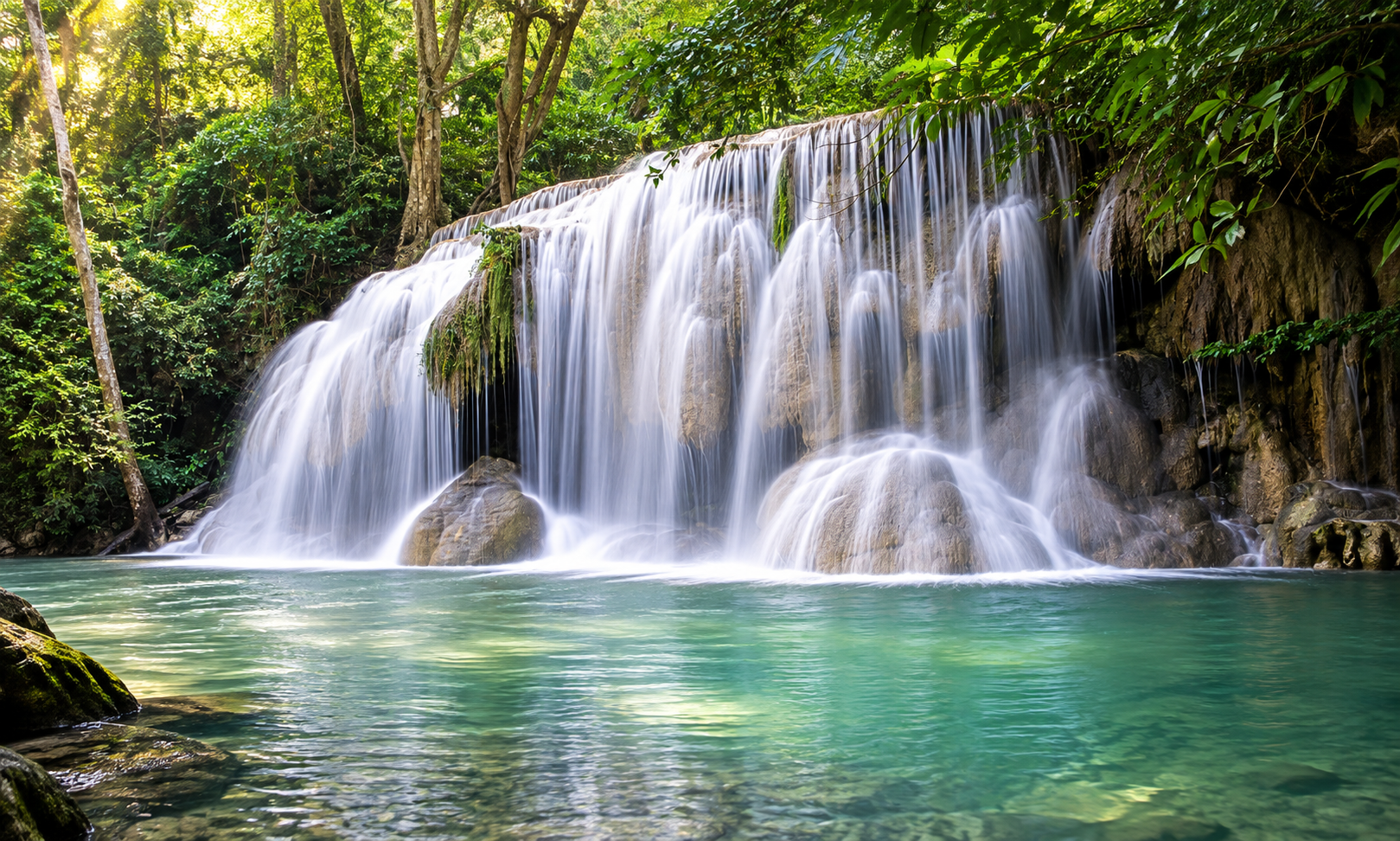
Erawan National Park is one of Thailand’s most remarkable examples. Hidden among the limestone mountains of western Kanchanaburi, the park is best known for the spectacular seven-tiered Erawan Waterfall — a sequence of cascades, natural pools, limestone formations and forest paths that gradually lead deeper into the landscape.
But Erawan is more than a waterfall.
Its forests form part of the larger mountain landscape of western Thailand. Its limestone geology has shaped cliffs, caves, streams and waterfalls. Its waterways support aquatic life, while the surrounding forests provide habitat for a wide variety of wildlife.
The famous seven levels are simply the most accessible expression of a much larger protected landscape.
Come for the emerald pools. Stay long enough to understand the mountain, forest and water system that created them.
Erawan National Park at a Glance
- Official Name
- Erawan National Park
- Thai Name
- อุทยานแห่งชาติเอราวัณ
- Province
- Kanchanaburi
- Region
- Western Thailand
- Districts
- Sai Yok, Si Sawat and Mueang Kanchanaburi areas
- Established
- 19 June 1975
- National Park
- 12th national park of Thailand
- Area
- Approximately 550 km²
- Landscape
- Limestone mountains, forest, streams, waterfalls and caves
- Highest Point
- Approximately 996 metres above sea level
- Signature Attraction
- Erawan Waterfall
- Waterfall Levels
- 7
- Waterfall Length
- Approximately 1.5 km from the lower section to the uppermost level
Why Erawan Matters
Erawan is one of the places where geology, water and forest come together unusually well.
The park lies within the western mountain system of Thailand, where limestone landscapes have been shaped over geological time by uplift, erosion, weathering and water.
Here, streams descend through the forest and encounter limestone formations that create a series of natural drops and pools. The result is Erawan Waterfall.
The water does not simply fall from one cliff. It moves through a sequence of different landscapes, creating seven named levels, each with its own character.
This is what makes Erawan particularly rewarding to explore on foot. The journey is not simply:
Entrance → Waterfall → Photograph → Leave.
It is a gradual transition from developed visitor areas into increasingly forested terrain.
The Landscape
Erawan National Park occupies a mountainous landscape in western Kanchanaburi. The terrain is dominated by forest-covered hills and limestone formations, with streams flowing through valleys and descending toward lower elevations.
The park’s highest elevations reach approximately 996 metres above sea level. This variation in elevation contributes to differences in vegetation, moisture, temperature and habitat.
From the visitor areas around the waterfall, the landscape may initially feel like a recreational forest park. Walk farther, however, and the environment becomes noticeably wilder.
The sound of visitors gradually gives way to running water, birds, insects and forest sounds.
That transition is an important part of the Erawan experience.

The Story Behind the Name
The park was formerly associated with the name Khao Salop.
The name Erawan became associated with the area because of the distinctive rock formation at the upper section of the waterfall.
At the seventh level, the limestone formation and falling water can create an appearance reminiscent of the three-headed elephant Erawan, the mythological elephant associated with Hindu and Thai cultural traditions.
The resemblance gave the waterfall — and subsequently the national park — its better-known name.
Thailand’s landscapes often carry both geological and cultural identities.
Erawan Waterfall
Thailand’s Famous Seven-Tiered Waterfall
Erawan Waterfall is the undisputed star of the national park. It descends for approximately 1.5 kilometres through a series of seven major levels.
Along the way, water flows over limestone surfaces, creating cascades, channels and natural pools. The water is often strikingly blue-green or emerald in appearance — influenced by clear water, limestone geology, mineral characteristics, depth, light and the surrounding forest.
It is one of the most recognizable waterfall landscapes in Thailand. But the seven levels are not identical. Each has its own atmosphere.
The Seven Levels of Erawan
1. Lai Khuen Rang
ไหลคืนรัง · The Beginning
The first level marks the beginning of the waterfall experience. It is the most accessible section and an easy place to slow down before continuing farther into the forest.
The landscape here is relatively gentle compared with the upper levels. For visitors travelling with children, older family members or limited walking time, the lower sections can already provide a rewarding experience.
You do not have to reach the summit to experience Erawan.
2. Wang Matcha
วังมัจฉา · The Classic Scene
Wang Matcha is one of the most popular sections of Erawan Waterfall. The water forms attractive pools surrounded by limestone and forest.
The combination of clear water, rock formations and vegetation creates the classic Erawan scene that appears in countless photographs. The name is associated with fish inhabiting the pools.
For many visitors, this is where the character of Erawan really becomes apparent.
3. Pha Nam Tok
ผาน้ำตก
At the third level, the landscape becomes more distinctly waterfall-like. Water moves over limestone surfaces and drops into natural pools below.
The surrounding forest becomes increasingly important to the experience. Instead of seeing the waterfall as an isolated attraction, visitors begin to understand it as part of a continuous stream-and-forest system.
4. Oke Nang Phisuea
อกนางผีเสื้อ
The fourth level introduces another change in the landscape. The rocks, pools and surrounding vegetation create a more intimate natural setting.
This section is associated with characteristic rock forms and the visual variety that gives the different levels their individual identities. The trail becomes increasingly interesting for visitors who enjoy observing the landscape rather than simply searching for the next swimming pool.
5. Buea Mai Long
เบื่อไม่ลง · “Never Getting Bored”
The name roughly conveys the idea of “never getting bored.” It is an appropriate name for a waterfall where the landscape changes again as the stream moves through limestone formations and larger pools.
By this point, the walk is no longer simply a short stroll from the visitor facilities. The forest begins to dominate the experience.
6. Dong Prueksa
ดงพฤกษา · The Forest Level
The sixth level is surrounded by a stronger sense of forest. Vegetation becomes an important part of the scene, framing the water and limestone formations.
This is where the journey begins to feel distinctly different from the lower recreational areas. The higher you go, the more the waterfall becomes a journey through a mountain ecosystem.
7. Phu Pha Erawan
ภูผาเอราวัณ · The Climax
The seventh and highest named level is the climax of the Erawan Waterfall trail. Here, the limestone formations create the distinctive shape associated with the head of the mythical Erawan elephant.
During periods of stronger flow, the falling water can emphasize this resemblance dramatically. Reaching the seventh level is therefore more than completing a hiking checklist. It provides the visual conclusion to the geological and hydrological sequence that began far below.
If you have the time and physical ability, this is the level worth walking for.
Why Is the Water So Blue-Green?
One of Erawan’s most photographed characteristics is the colour of its pools. The water can appear turquoise, blue-green or emerald depending on sunlight, water conditions, depth and the surrounding environment.
Limestone plays an important role. As water moves through limestone terrain, geological processes influence the chemistry and physical character of the stream. Light then interacts with the clear water and pale mineral-rich surfaces beneath it.
The result is the distinctive colour associated with Erawan. It is therefore misleading to think of the colour simply as a “natural swimming pool effect.”
The pools are part of a functioning geological and aquatic system.
The Geology of Erawan
Erawan is particularly interesting from a geological perspective. The park’s limestone landscape has been shaped by geological structures, weathering and erosion.
The waterfall itself is associated with geological structures that create changes in elevation along the stream. Limestone has also influenced the formation of caves, cliffs, pools and unusual rock surfaces throughout the park.
In other words:
The waterfall exists because of the mountain.
And the mountain’s geology determines much of the waterfall’s character. This is one reason Erawan should be appreciated not simply as a beautiful waterfall, but as a living geological landscape.
Caves of Erawan
The national park contains several limestone caves. Some are accessible only under specific conditions or with appropriate permission, while others are closed to visitors.
This distinction is important. A national park is not an amusement park where every natural feature should be entered. Caves can contain unstable surfaces, darkness, slippery rock, wildlife habitat and sensitive geological formations.
Tham Phra That
A substantial limestone cave known for its stalactites, stalagmites and distinctive geological formations. The cave is located away from the main waterfall visitor zone and requires a separate approach.
Tham Wang Badan
A larger limestone cave system associated with underground water and cave formations. Visitor access has been restricted or closed at various times, so current access should always be confirmed with park authorities.
Tham Mi & Tham Rua
Further limestone caves within the park’s underground landscape. They demonstrate that Erawan’s environment below ground is as important as the scenery above it.
Forests, Wildlife & Water
Forests & Vegetation
Erawan’s forests are not a single uniform ecosystem. The park contains different forest communities, with mixed deciduous forest forming a major component of the landscape, alongside dry evergreen and dry dipterocarp elements.
This vegetation mosaic reflects differences in elevation, soil, moisture and exposure. During the dry season, deciduous forest can change dramatically as trees shed leaves. During wetter periods, the landscape becomes greener and streams generally become more vigorous.
Wildlife
Erawan lies within a larger forest landscape in western Thailand that supports considerable biodiversity. Wildlife associated with the broader area includes Asian elephants, gibbons, sambar deer, barking deer, serow, wild boar and various small mammals.
The wider forest also provides habitat for numerous bird species, reptiles, amphibians and insects. Large predators are much more difficult to encounter. Visitors should never assume that the absence of sightings means the animals are absent.
The recent discovery of tiger tracks near the park boundary in September 2026 is a useful reminder that the western Thai forest complex remains ecologically significant.
Wild animals should always be observed from a safe distance and never approached, fed or followed.
The River & Aquatic Life
Water is the defining ecological element of Erawan. The streams feeding the waterfall create a chain of aquatic habitats. The pools are home to fish and other aquatic organisms.
Visitors sometimes focus on the “fish spa” experience created by small fish interacting with people’s feet, but the ecological perspective is more interesting. These pools are natural aquatic habitats, not artificial bathing facilities.
Swimming should always follow the park’s current rules and designated areas.
Nature Trails
Erawan is not limited to the main waterfall trail. The park also provides opportunities for visitors interested in walking through the forest rather than simply visiting the waterfall.
- Erawan Nature Trail
- Approximately 1 kilometre. A chance to observe forest environments, viewpoints and vegetation without committing to the full waterfall climb.
- Khao Hin Lan Pee Nature Trail
- A considerably more demanding route for experienced hikers. It requires more physical preparation and, depending on current park regulations, may require permission or ranger assistance.
Erawan has both easy recreational walking and genuine nature-trail experiences.
The Experience Changes as You Climb
One of the best ways to understand Erawan is to think of the waterfall as a vertical journey.
- Lower Erawan
- More accessible, more facilities, more visitors, easier walking — good for families.
- Middle Erawan
- More natural scenery, more walking, more limestone formations, a greater sense of immersion.
- Upper Erawan
- Steeper and more demanding, fewer facilities, more forest, more rewarding for hikers — a stronger feeling of being inside the landscape.
This makes Erawan suitable for different kinds of visitors. You do not have to complete the entire route.
When to Visit Erawan
Erawan can be beautiful throughout the year, but the character of the waterfall changes with weather.
- Rainy Season
- Greater water volume, greener forest and more dramatic falls. Heavy rain also increases slippery trails, rapidly changing water and temporary restrictions. Follow current instructions from park staff.
- Cool Season · November–January
- Generally one of the most comfortable periods. Temperatures are more pleasant, especially in the morning. Cooler weather and clearer skies can make hiking enjoyable.
- Hot Season · February–April
- Considerably warmer. Water remains an attraction, but some streams may be lower. Wildfire and haze risks can rise in western Thailand, and the park may impose temporary closures.
The Best Time of Day
For the best overall experience, start early. Morning offers cooler temperatures, softer light, fewer visitors than peak periods, more time to explore and better conditions for photography.
Weekends and public holidays can become substantially busier. If your priority is photography or a quieter experience, early morning is strongly preferable.
How Long Should You Spend?
- Short visit · 2–3 hours
- Suitable if you mainly want the lower waterfall levels: the visitor area, Level 1, Level 2 and selected sections beyond.
- Half day · 4–5 hours
- A better option for first-time visitors. Walk progressively through the levels, stop for photographs and spend time around the pools where permitted.
- Full day
- Best if you want to combine the waterfall with nature trails or other attractions nearby. Do not underestimate the time required for walking, swimming, photography and returning downhill.
Who Will Enjoy Erawan Most?
- Families
- The lower levels are relatively accessible and provide a strong introduction to the park.
- Photographers
- Limestone, turquoise water, forest and cascading streams create excellent natural compositions.
- Nature lovers
- The surrounding forest and geological landscape provide much more than the famous waterfall.
- Hikers
- The upper levels and longer trails offer progressively more demanding walking.
- First-time visitors to Kanchanaburi
- Erawan is one of the province’s defining natural attractions.
- Slow travellers
- Erawan rewards visitors who stop looking for the “best photo” and begin observing the landscape.
Who Should Plan More Carefully?
Visitors with limited mobility, very young children, serious knee or joint problems, low hiking fitness, fear of slippery terrain, or medical conditions affected by heat or exertion should treat the upper trail with care.
The lower sections can still be enjoyable. Reaching all seven levels is not necessary.
The goal should not be: “I must reach Level 7.”
The better goal is: “I want to experience Erawan at a pace that suits me.”
Swimming, Food & Overnight Stay
Swimming at Erawan
Swimming is one of the attractions of the waterfall. However, the pools are natural environments. Conditions can change with rainfall, water flow and park management decisions.
- Swim only where permitted
- Follow warning signs
- Obey temporary closures
- Avoid swimming in dangerous water
- Keep children under close supervision
- Avoid jumping from rocks
- Never climb unstable waterfall formations
- Never leave rubbish behind
Natural beauty is not an invitation to ignore natural hazards.
Food & Facilities
The main visitor area has facilities designed to support visitors, including food and refreshment areas, parking and basic visitor services. As you move farther up the waterfall, facilities become more limited.
This is intentional. The upper waterfall should be treated as a natural environment rather than a commercial recreation zone. Plan accordingly and follow the park’s current restrictions on food, drinks and waste.
Accommodation & Camping
Erawan National Park provides accommodation and camping facilities in the park area, subject to availability and current park regulations. Staying overnight can be a good option for visitors who want to explore more slowly. It also allows an earlier start at the waterfall.
For peak weekends, holidays and high-season periods, check availability and reservation requirements in advance. Do not assume that accommodation, camping areas or equipment rental will always be available without reservation.
How to Get to Erawan National Park
Erawan National Park is located in Si Sawat District, Kanchanaburi Province, approximately 60–70 kilometres from Kanchanaburi town depending on the route and destination point.
From Kanchanaburi, the main approach follows the road toward the Srinagarind Dam area and Erawan.
By Private Car
Driving is the easiest option for visitors who want flexibility. From Kanchanaburi, follow the route toward Srinagarind Dam and continue to Erawan National Park. A private vehicle is particularly useful if you want to combine Erawan with other destinations in Si Sawat or along the reservoir.
By Public Transport
Public transport from Kanchanaburi is possible, although services are less flexible than private transport. Check the current departure and return schedules before starting the trip. Do not rely on an old timetable found online.
Entrance Fees & Visitor Information
The current national-park fee schedule places Erawan in a fee group with the following admission rates:
- Thai adult
- 60 THB
- Thai child
- 30 THB
- Foreign adult
- 300 THB
- Foreign child
- 150 THB
Vehicle charges may apply separately. Because government fees and operating policies can change, verify the current rate with the park or the Department of National Parks before travelling.
Responsible Travel at Erawan
Erawan is beautiful precisely because it remains a functioning natural environment. Help keep it that way.
- Leave no trace — take rubbish with you
- Do not feed wildlife
- Stay on designated trails
- Do not remove rocks or natural objects
- Respect water restrictions and closures
- Keep noise down
- Do not touch or damage cave formations
Stalactites and stalagmites can take extremely long periods to form. Feeding animals changes their behaviour and can create conflict between wildlife and visitors.
Photography Guide
Erawan is one of those destinations where the most obvious photograph is not necessarily the best photograph. Instead of photographing only the waterfall, look for relationships:
Water + limestone + forest · Human scale + landscape · Light + water · Texture + movement
- Early morning
- Soft light works particularly well around the lower levels.
- After rain
- Water volume can transform the appearance of the falls.
- Midday
- Strong sunlight can intensify the blue-green appearance of the pools but may create harsh contrast.
- Upper levels
- Look beyond the obvious waterfall. Forest, rock texture and smaller cascades can produce more distinctive images.
Erawan Beyond the Waterfall
The waterfall is the reason most people arrive. The national park, however, is considerably larger than the waterfall area.
The wider protected landscape includes mountain forests, limestone formations, caves, streams, wildlife habitat, nature trails, viewpoints, remote ranger areas and connections with the wider western forest landscape.
The waterfall is the icon. The forest is the ecosystem.
Nearby Experiences
- Srinagarind Dam & Reservoir
- A major water landscape near Erawan, surrounded by forested mountains and scattered islands.
- Kanchanaburi
- The provincial capital provides access to the River Kwai area, historical sites, museums and accommodation.
- Sai Yok National Park
- Another major natural destination in western Kanchanaburi, known for waterfalls, river landscapes and forest.
- Si Sawat
- The district surrounding Erawan provides a quieter gateway into the mountainous interior of Kanchanaburi.
Frequently Asked Questions
- What is Erawan National Park?
- Erawan National Park, or อุทยานแห่งชาติเอราวัณ, is Thailand’s 12th national park, established on 19 June 1975 in Kanchanaburi. It covers about 550 km² of limestone mountains, forest, caves and the seven-tiered Erawan Waterfall.
- How many levels does Erawan Waterfall have?
- Seven major levels, from Lai Khuen Rang at the lower section to Phu Pha Erawan at the top.
- How long is Erawan Waterfall?
- The main waterfall sequence extends for approximately 1.5 kilometres from the lower section to the uppermost level.
- Can you swim at Erawan National Park?
- Swimming is permitted in designated areas when conditions allow. Always follow current park instructions, warning signs and temporary closures.
- Is Level 7 of Erawan difficult?
- It is considerably more demanding than the lower levels. Visitors should allow enough time, water and energy for the return journey.
- Is Erawan suitable for families?
- Yes, particularly the lower sections. Families do not need to reach all seven levels.
- Is Erawan only a waterfall?
- No. The national park contains forests, limestone landscapes, caves, streams, wildlife habitat and nature trails.
- Can you stay overnight at Erawan National Park?
- Yes, accommodation and camping facilities are available subject to current availability and park regulations.
- What is the best time to visit Erawan?
- Early morning is generally best for cooler conditions, softer light and a quieter experience. November through January is often the most comfortable hiking period. Water volume is usually greater in the rainy season.
- How far is Erawan from Kanchanaburi?
- The park is roughly 60–70 kilometres from Kanchanaburi town, depending on the specific destination within the park.
- How do I get to Erawan National Park from Kanchanaburi?
- Erawan is in Si Sawat District. From Kanchanaburi, the main approach follows the road toward Srinagarind Dam and continues to the park. Driving is the most flexible option; public transport is possible if you check current return times.
- What is the entrance fee for Erawan National Park?
- The current national-park fee group listed here is 60 THB for Thai adults, 30 THB for Thai children, 300 THB for foreign adults and 150 THB for foreign children. Vehicle charges may apply separately, and official fees can change.
Related Destinations
- Sai Yok National Park
- Waterfalls, river landscapes and forest further west in Kanchanaburi.
- Nature & Parks
- More protected landscapes across ThailandLover’s national-park collection.
Location
Find Erawan National Park
Tha Kradan, Si Sawat, Kanchanaburi 71250