

Introduction
ThailandLover wrote this for two readers: the visitor who wants a car for a few days, and the person who already lives here and is choosing between a monthly lease and a car in their own name. Rental desks set the deposit. The Department of Land Transport registers the car. The Office of Insurance Commission sets the compulsory cover. Read the contract, then check the rule that applies to your visa.
01 · Visitors
Renting a car as a foreigner
เอกสารเช่ารถสำหรับชาวต่างชาติA foreigner can rent a car when the passport is still valid and the licence matches both Thai law and that company’s own rules. Bring the papers below. Ask about anything extra before you reach the counter.
Passport
A passport that is still in date. This is the identity document every desk starts with.
Driving licence
An International Driving Permit with your home licence, or a foreign licence the company accepts. A Thai licence works as well.
Credit card
Used for payment and the security deposit. A few companies rent without a card. Confirm that before you arrive.
Extra papers
Some desks also ask for a work permit, or a return air ticket when the stay is short. It depends on the company.
02 · Long stays
Monthly and yearly leases
เช่ารายเดือนสำหรับคนอยู่ยาวIn 2026, large rental firms and many local companies run monthly and yearly plans for people who live here: employees, digital nomads, and holders of long-stay visas such as long-term residency or retirement. The terms are more flexible than a holiday rental. The paperwork is heavier.
What the desk usually adds
Passport and an International Driving Permit are the start. Long-stay plans also ask you to show that you actually live here.
- Passport and a long-stay visa A non-immigrant visa such as work (B), retirement or family (O), LTR, or Smart Visa. See visa and entry for how those stays differ.
- Work papers, if you have them A work permit, or a salary letter or employment contract from a company in Thailand.
- Licence Most expats convert to a Thai licence, because it is cleaner with the police and with insurance. New arrivals can begin with an IDP plus the home licence.
- Proof of address A condo or house lease, or the yellow house-registration book (ท.ร. 13).
- Deposit A credit card hold is still common. Some expat plans debit each month, or accept employment papers in place of a card.
Typical 2026 quote
฿13,800–16,900 a month
A small eco sedan such as a Toyota Yaris or Honda City often starts in this range. That is roughly 15–25% below the same car rented by the day. Quotes move with the company and the model.
Useful if the dates are open
Month to month
Cancel or change the model with 7–30 days’ notice. A longer lease makes sense once you know how long you are staying.
What “all-inclusive” usually means
The ownership chores are in the price
Most expat plans fold in Type 1 insurance, the annual road tax and compulsory พ.ร.บ., a replacement car after an accident, and scheduled servicing. You skip the paperwork of owning the car.
Who it suits
A stay with an end date
A contract is easier to leave than a car you still owe money on. People who may move city, or country, often start here. Working and digital nomad life is a common case.
Before you sign
Read the English contract
Ask what the deposit covers, how many days’ notice a swap needs, and whether the replacement car is the same class. The headline monthly price is not the whole deal.
| Company | What expats notice | Where they operate |
|---|---|---|
| Drive Car Rental (long term) | Contracts from six months, new cars, and a replacement car soon after an accident. | Bangkok, Phuket, Chiang Mai, Pattaya, and other main tourist cities. |
| True Leasing (Expat Plan) | Aimed at expats and digital nomads, with English-speaking support. | Bangkok, Chiang Mai, Phuket, Krabi, and Pattaya. |
| Siam.rent / Sawasdee Rent A Car | Built for foreigners who live in Thailand. Straightforward terms, and easy to reach on WhatsApp or LINE. | Bangkok and larger cities. |
| Eazy Car (Flexi) | A monthly subscription. You choose a short or a long term. | Bangkok and the surrounding provinces. |
ThailandLover lists these as companies that publish long-stay plans for foreign residents. Deposits, English contracts, and replacement-car rules change. Confirm the current offer with the company before you sign.
03 · Ownership
Buying a car in your own name
ซื้อสด หรืองวดผ่อนA foreigner can legally buy a new car, including one still on red plates (ป้ายแดง), or a used car. The blue registration book (เล่มทะเบียนสีน้ำเงิน) can carry that person’s own name. Cash and finance are different conversations.
Passport and visa
A long-stay non-immigrant visa: work (B), marriage or family (O), retirement, LTR, or Smart Visa. A tourist visa is not accepted for a purchase.
Proof you live here
A Certificate of Residence from Immigration or from your embassy in Thailand, or the yellow house-registration book (ท.ร. 13).
Work permit
Bring it if you have one. Cash purchases can proceed without it. Most finance applications cannot.
Cash · the simpler path
Pay, then register
Walk into a showroom or a used-car yard with the papers above and pay in full. The dealer registers the car with the Department of Land Transport in your name.
- New cars and used cars both qualify.
- The blue book is issued in the foreigner’s name.
- The first พ.ร.บ. is usually arranged with that registration.
Finance · stricter
The bank wants you to stay
Thai banks and finance companies do lend to foreigners. The conditions are there to limit the chance you leave before the loan ends.
- Work and income. A work permit and steady employment in Thailand, often one to two years, plus Thai bank statements and salary slips.
- A larger deposit. Down payments commonly start at 20–30% of the car’s price, higher than many Thai buyers are asked for.
- A Thai guarantor. Most lenders want a Thai national with stable income to sign alongside you.
The licence can wait until you drive
A Thai licence is not required on the day you buy. It is required once you are on the road. Type 1 insurers are much easier to deal with when that licence is Thai, because a claim is less likely to turn into an argument about the permit.
You can sell it later
Once the car is legally yours, a later move or a change of car goes through the ordinary Department of Land Transport transfer, to a Thai buyer or to another foreigner.
04 · If you own the car
Renew พ.ร.บ. every year
ประกันภาคบังคับ คุ้มครองคน ไม่คุ้มครองรถCompulsory cover is a yearly duty for every registered car and motorcycle. Voluntary insurance is the separate policy that can repair the vehicle.

Let it lapse and the fine can reach 10,000 baht. The Department of Land Transport will also refuse the annual road-tax sticker.
What the law actually buys
พ.ร.บ. is compulsory motor insurance under the Protection for Motor Vehicle Accident Victims Act B.E. 2535 (1992). Every registered car and motorcycle in Thailand must carry it.
It pays medical costs, or funeral costs, to anyone injured or killed in a motor accident: the driver, a passenger, or a pedestrian. The first payment does not wait for anyone to decide who was at fault.
It does not repair your car, and it does not repair the other driver’s car. That is what Type 1, Type 2, or Type 3 insurance is for. Showrooms and finance companies usually arrange the first พ.ร.บ. together with the registration.
Paid first, before fault is decided
The insurer must pay within seven days of receiving the documents. This portion is there for urgent treatment.
- Medical treatment, actual cost up to ฿30,000 / person
- Death, loss of an organ, or permanent disability ฿35,000 / person
- Injury followed by death, combined not over ฿65,000 / person
Paid later, if you were not at fault
Once the police find your side was not at fault, or you were a passenger who was not at fault, a further payment can follow.
- Medical treatment, actual cost up to ฿80,000 / person
- Death, or total permanent disability ฿500,000 / person
- Loss of an organ ฿200,000–500,000
- Hospital recovery ฿200 / day, up to 20 days
พ.ร.บ. policy
An A4 document with a silver sticker strip. Treatment and funeral costs for people — never bodywork.
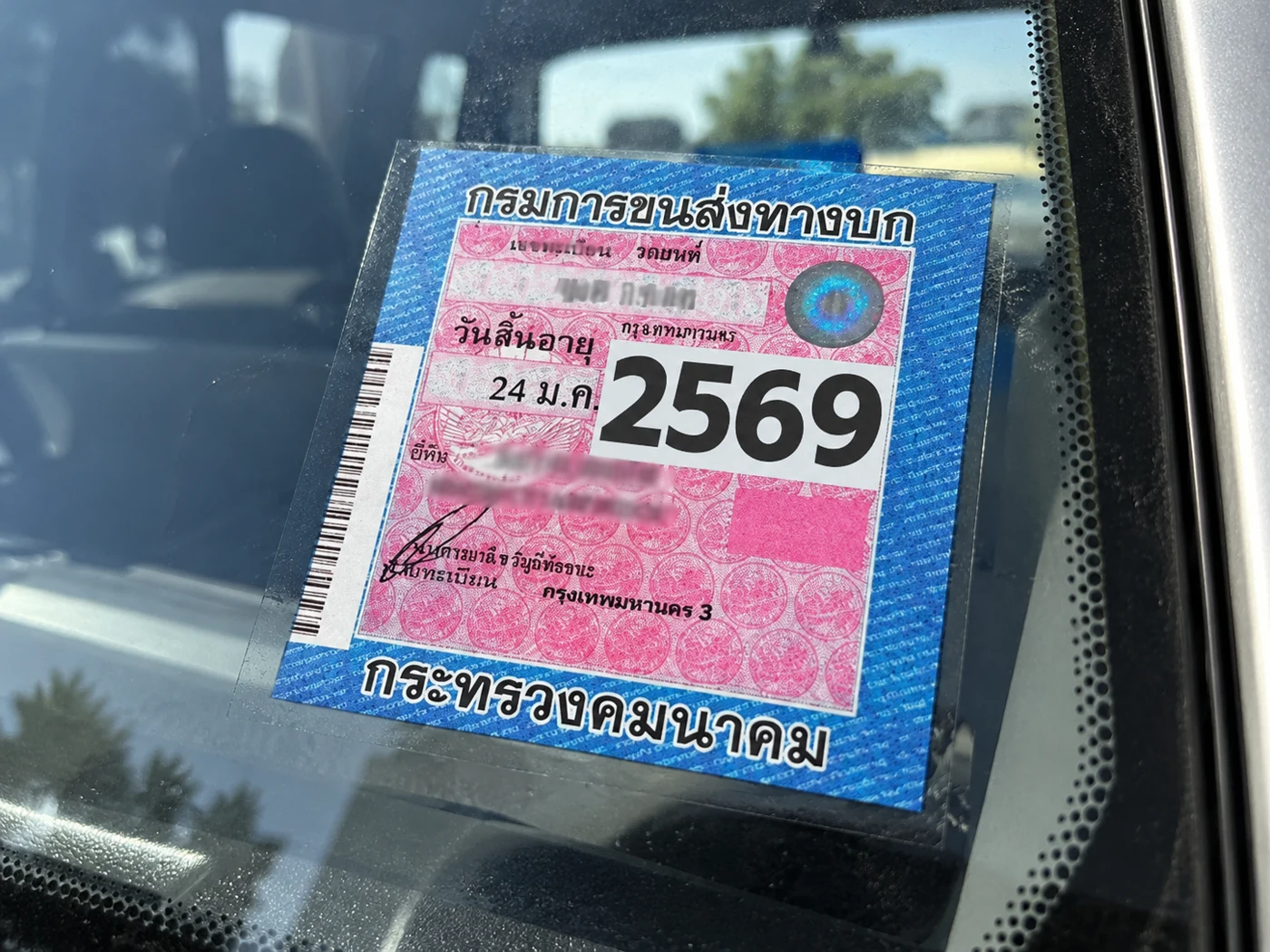
Road-tax sticker
Proof the annual tax is paid. You only get it after a valid พ.ร.บ. is on file.
Type 1, 2, or 3
Optional insurance you buy on top. This one can pay to repair the vehicle.
Renew checklist
How long-stay residents renew พ.ร.บ.
Treat it as a short yearly sequence. First get a valid พ.ร.บ., then use it to renew the road tax. Bring the blue registration book, the current policy if you still have it, and ID that matches the owner’s name on the book.
-
1
Check the dates
Look at the tax sticker on the glass, or open the Tang Rath / DLT app. Note when the road tax expires, and when the current พ.ร.บ. ends.
-
2
Buy or renew พ.ร.บ.
Get a new policy before the tax trip. Under the 2026 rules, the cover must run at least until the next tax expiry date — not just “about one year.”
-
3
Inspect if the vehicle is old enough
Cars registered for seven years or more, and motorcycles for five years or more, need a ตรอ. inspection certificate before the tax can be renewed.
-
4
Pay the road tax and stick the new sticker
Take the พ.ร.บ. proof (and the inspection paper if required) to renew the tax. Put the new sticker on the glass. Keep the policy with the blue book.
Where to do steps 2–4
Land Transport offices
Provincial and Bangkok DLT offices often have insurer counters on site. One trip can cover พ.ร.บ. and the road tax.
Private inspection stations (ตรอ.)
Best when step 3 is required: many stations inspect and renew พ.ร.บ. in the same visit.
Insurers and brokers
Agents and brokers can issue the policy on the spot. A Thai-speaking friend helps if the desk runs only in Thai.
Post offices
Many Thailand Post counters sell พ.ร.บ. and can handle the road-tax renewal. Handy outside the big cities.
Counter Service / 7-Eleven
Pay and renew through Counter Service at many 7-Eleven stores. Confirm the branch still offers the service before you queue.
06 · In force now
The 2026 พ.ร.บ. rules
คำสั่งนายทะเบียนที่ 16/2569 และ 17/2569The Office of Insurance Commission revised the motor พ.ร.บ. for B.E. 2569 in Registrar Orders 16/2569 and 17/2569. The new term rules have been in force since 1 September 2026. The point is to line the พ.ร.บ. up with the annual road-tax date, so the car is not briefly uninsured between the two.
The policy no longer has to be exactly one year
It used to be sold for 365 days. You can now buy a short policy, under one year, or a long one, over one year and not more than two. The premium is averaged per day for the exact number of days.
Tax renewal needs cover that reaches the next expiry
If you want to use the พ.ร.บ. as proof when you pay the annual road tax, the cover must run at least until the tax expiry date in the following year. If it stops short, the Department of Land Transport system can refuse the renewal.
You cannot cancel because you changed your mind
Since 7 August 2026, an insured person may cancel only in two cases: there is legal evidence the vehicle has been taken out of use, or a second พ.ร.บ. was issued for the same car. The rule stops people buying a policy, renewing the tax, and then cancelling.
| Item | What to know |
|---|---|
| Papers for a new พ.ร.บ. | The registration book, the current policy, and the tax sticker or the due date from the Tang Rath app or the DLT app. |
| Cover limits | Unchanged. The amounts in the section above still apply. The 2026 orders did not cut them. |
| Vehicle inspection | Cars registered for seven years or more (a 2019 registration reaches that mark in 2026) and motorcycles registered for five years or more must pass inspection at a ตรอ. station before the road tax can be renewed. |
07 · Short answers
Questions people ask first
Can a foreigner rent a car in Thailand?
Yes. Bring a valid passport, a licence the company and Thai law both accept, and a credit card for the deposit unless the company has already agreed another arrangement.
Can a foreigner buy a car in Thailand?
Yes, new or used, with the blue registration book in your own name. You need a long-stay non-immigrant visa and a Certificate of Residence or the yellow house book. A tourist visa is not accepted.
Do I need a Thai licence to buy a car?
Not on the purchase day. You need a valid licence to drive, and a Thai licence makes Type 1 insurance much simpler if there is a crash.
What does พ.ร.บ. pay for?
People. Urgent medical costs, and funeral costs, for anyone hurt or killed in a motor accident. It does not pay to repair a car. That is voluntary Type 1, 2, or 3 insurance.
Where can I renew พ.ร.บ.?
Follow four steps: check the dates, buy พ.ร.บ., inspect if the vehicle is old enough, then pay the road tax. Do the errands at Land Transport offices, ตรอ. stations, insurers or brokers, post offices, or Counter Service at many 7-Eleven stores. Online insurer apps work well for the policy itself; tax payment online may need a Thai ID.
This page is a guide from ThailandLover. It is not a rental contract, a loan offer, or a ruling from the Department of Land Transport or the Office of Insurance Commission. Visa categories, deposits, and พ.ร.บ. dates change. Confirm them with the office that will stamp the paper.
More from ThailandLover
Getting Around
BTS and MRT, boats, buses, songthaew, and when a private driver is the calmer choice.
ExploreVisa & Entry
Tourist stays, and the longer visas a car purchase actually requires.
ExploreLong Stay & Retirement
Retirement and other long-stay paths for readers who are building a life here.
Explore