

Historical Park · Sukhothai
Si Satchanalai Historical Park
อุทยานประวัติศาสตร์ศรีสัชนาลัย
The Quiet Historic City Behind the Sukhothai Kingdom
Si Satchanalai · Yom River · Sukhothai
Away from the better-known monuments of Sukhothai lies another extraordinary chapter of Thailand’s early history — a religious city, a ceramic centre, and a quieter UNESCO landscape of trees, hills and river.
More Than a Collection of Old Temples
Si Satchanalai Historical Park preserves the remains of an ancient city closely connected with Sukhothai. It played an important religious, political and economic role in the Sukhothai Kingdom.
Set beside the Yom River and surrounded by hills, the city developed in a landscape that offered both fertile land and natural protection. Today its quiet ruins, forested surroundings, ancient temples and distinctive Sukhothai architecture feel very different from the larger and more heavily visited Sukhothai Historical Park.
It was a major historic city, religious centre and ceramic-production centre within the Sukhothai world. UNESCO recognises Si Satchanalai together with Sukhothai and Kamphaeng Phet as the Historic Town of Sukhothai and Associated Historic Towns, inscribed on the World Heritage List in 1991.
Sukhothai tells the story of a kingdom. Si Satchanalai reveals the people, beliefs, craftsmanship and trade that helped make that kingdom possible.
At a Glance
- 45.15 km²
- Historical park area — 28,217 rai.
- 281 sites
- Recorded historical sites across the park.
- 1991
- UNESCO inscription, with Sukhothai and Kamphaeng Phet.
- Yom River
- The plain and hills that shaped the city.
- Ceramics
- Sawankhalok ware, made for trade far beyond the kingdom.
- Official Name
- Si Satchanalai Historical Park
- Thai Name
- อุทยานประวัติศาสตร์ศรีสัชนาลัย
- Province
- Sukhothai
- District
- Si Satchanalai
- Setting
- Yom River plain and surrounding hills
- World Heritage
- Historic Town of Sukhothai and Associated Historic Towns
- UNESCO Inscription
- 1991
- Area
- 45.1472 km² / 28,217 rai
- Recorded Sites
- 281
- Main Zones
- Walled city, Chaliang, surrounding hills and kiln sites
- Best Known Sites
- Wat Chang Lom, Wat Chedi Chet Thaeo, Wat Nang Phaya, Wat Phra Si Rattana Mahathat Chaliang, Wat Chom Chuen, Wat Chao Chan
- Signature Heritage
- Sukhothai architecture, Buddhist monuments and Sawankhalok ceramics
The Fine Arts Department states that the historical park covers 45.1472 square kilometres (28,217 rai) and contains 281 historical sites.
Why Visit Si Satchanalai?
If Sukhothai is the great political centre of the kingdom, Si Satchanalai reveals another side of that civilisation. UNESCO describes Sukhothai as the political and administrative capital, while Si Satchanalai functioned as a spiritual centre and an important centre of ceramic production.
The city also feels different physically. Ancient monuments appear among trees, hills and the Yom River, giving the site a quieter and more atmospheric character.
- Sukhothai
- The former political and administrative capital, with an extensive monumental landscape.
- Si Satchanalai
- A religious and ceramic-production centre, enclosed by river, hills and forest.
It is one of the clearest places to understand how the Sukhothai world extended beyond its famous capital, especially if you care about:
- Thai history and ancient cities
- Buddhist architecture and Sukhothai art
- Archaeology
- Traditional ceramics
- Photography and cultural landscapes
A City Shaped by the Yom River
The location was not accidental. The ancient city developed on the Yom River plain, with hills including Khao Phra Si, Khao Phra Bat and Khao Yai surrounding the settlement. Fertile river land and elevated terrain provided both resources and natural defensive advantages.
Archaeological information from the Fine Arts Department indicates that human settlement here predates the Sukhothai period, with evidence extending back into the prehistoric era. Excavations at Wat Chom Chuen have revealed earlier communities and later cultural development.
The story of Si Satchanalai does not begin with the Sukhothai Kingdom. That period is one important stage in a much longer history of settlement.
From Chaliang to Si Satchanalai
The ancient landscape contains Chaliang and Si Satchanalai, which developed in close proximity. The Fine Arts Department describes an earlier settlement at the Yom River bend known as Chaliang. The centre of the city was later shifted approximately 1.5 kilometres north, where it became known as Si Satchanalai.
That is why visitors meet major monuments both inside the main walled city and outside it. The area is better understood as a broader historic urban landscape than as one compact archaeological compound.

Si Satchanalai in the Sukhothai Kingdom
During the Sukhothai period, Si Satchanalai became one of the kingdom’s important cities. The Fine Arts Department describes Si Satchanalai and Sukhothai as important cities within the same political system, and historical inscriptions connect Si Satchanalai with the royal history of Sukhothai.
Its importance was not only political. It became a major religious centre, with numerous monasteries and monumental Buddhist structures. That religious role is one reason the surviving ruins hold such a rich concentration of temples and stupas.
The Age of Sukhothai Art
Si Satchanalai is essential for understanding what is commonly called Sukhothai art and architecture. The monuments combine earlier traditions with innovations of the Sukhothai period. UNESCO identifies the monuments and sculpture of Sukhothai, Si Satchanalai and Kamphaeng Phet as important evidence of the development of early Siamese architecture and art.
Look closely at:
- Lotus-bud forms and bell-shaped stupas
- Walking Buddha images
- Stucco decoration
- Laterite construction and brick architecture
- Monumental Buddha images and temple layouts
The famous walking Buddha, in particular, became one of the most recognisable artistic expressions of the Sukhothai tradition.
Wat Chang Lom
วัดช้างล้อม · the temple of the elephant chedi
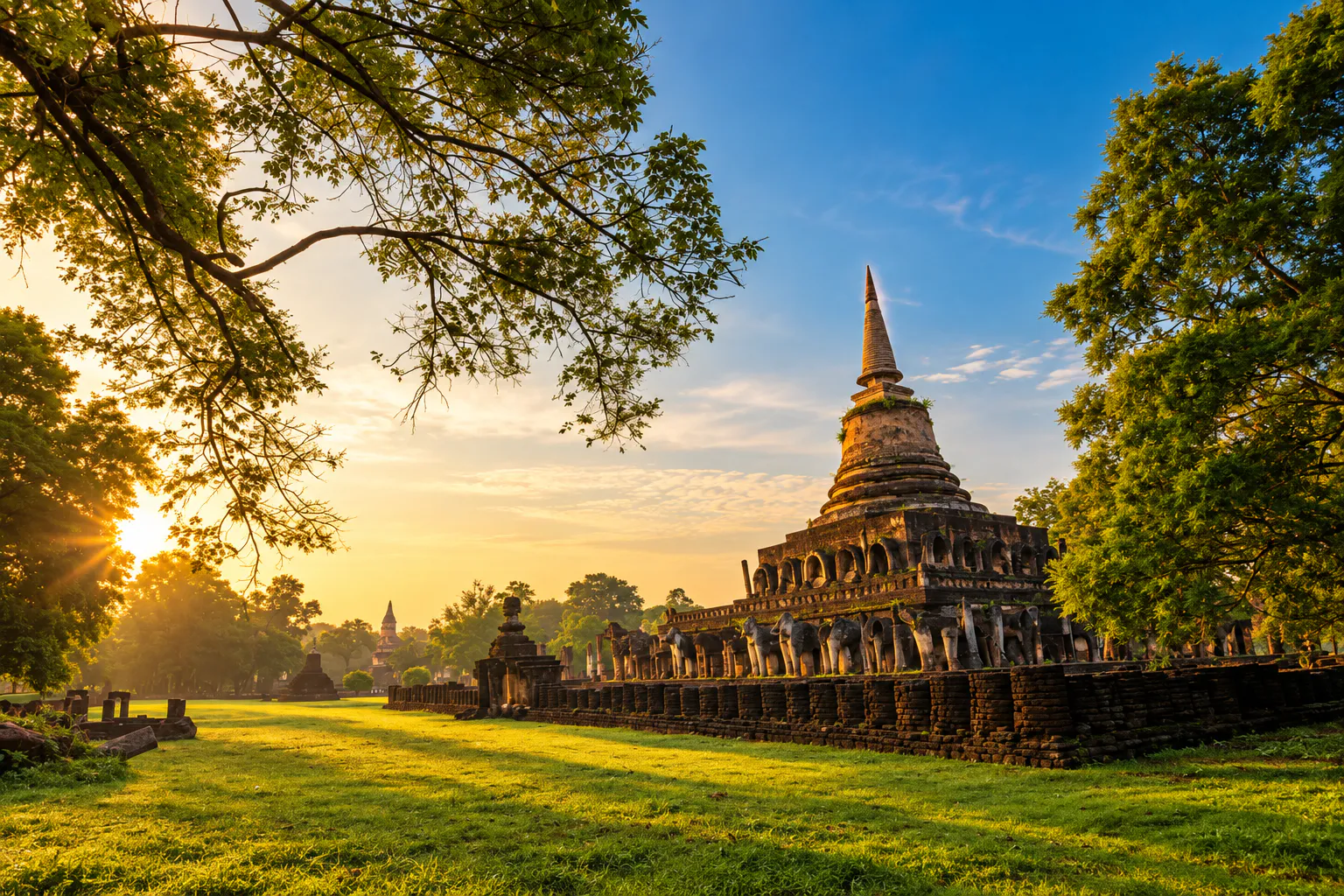
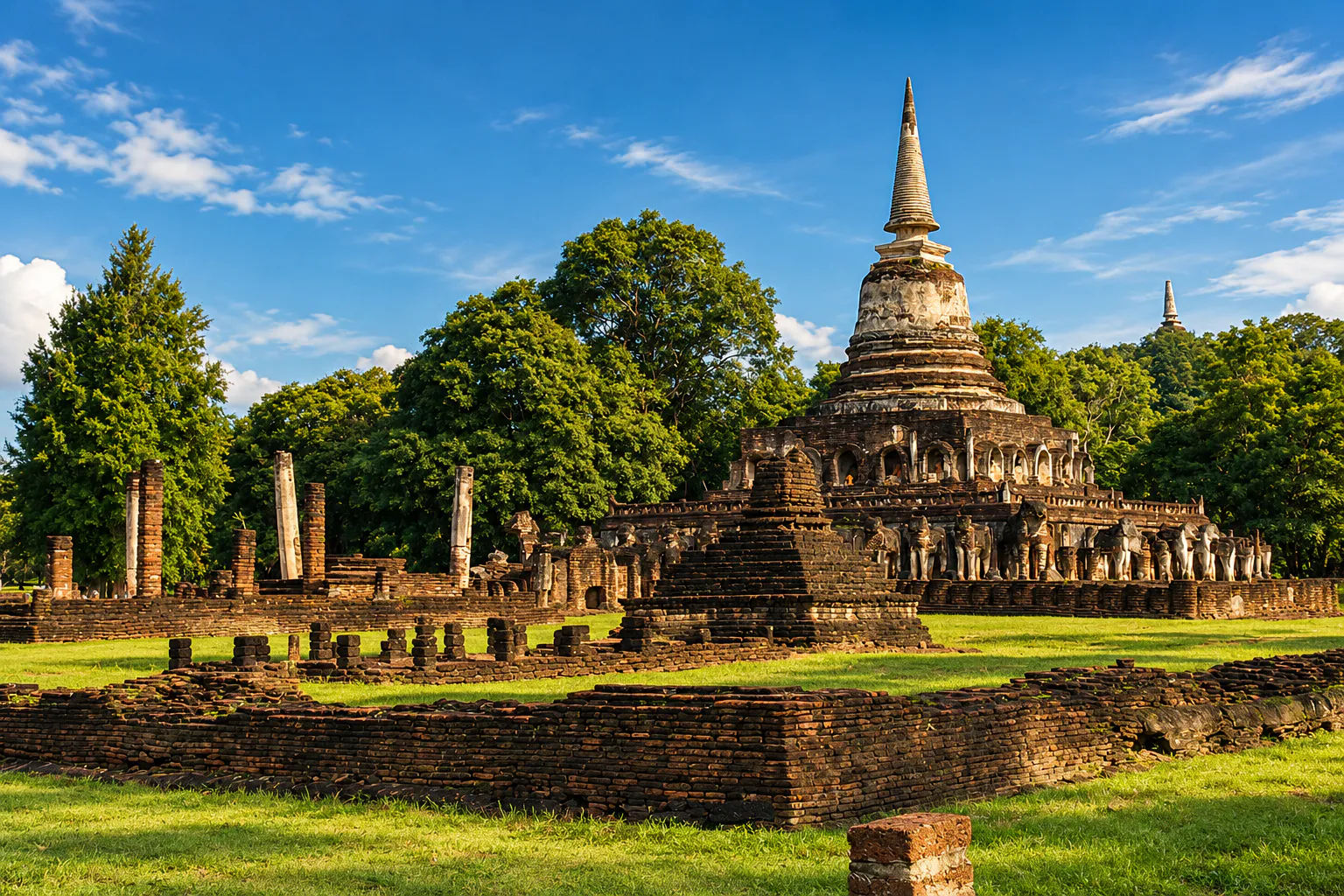
Wat Chang Lom is one of the most recognisable monuments inside the ancient city. Its central chedi is surrounded by elephant sculptures, one of the most distinctive visual features of Si Satchanalai. The elephants appear to support or emerge around the base of the monument, connecting architecture, symbolism and Buddhist imagery.
The temple is particularly photogenic in the early morning and late afternoon, when warm light emphasises the texture of the laterite and stucco.
Wat Chedi Chet Thaeo
วัดเจดีย์เจ็ดแถว · a gallery of stupa forms
Wat Chedi Chet Thaeo is one of the most important and visually complex temples in the city. The name is commonly translated as “Temple of Seven Rows of Chedis.”
It holds a large group of chedis in different forms and styles, showing the range of architectural ideas present in the ancient city. Rather than one monumental structure, the temple offers a composition of multiple stupas. This is where Si Satchanalai’s role as a centre of religious architecture becomes especially clear.
Wat Nang Phaya
วัดนางพญา · the temple of elegant stucco
Wat Nang Phaya is another major monument within the walled city, particularly known for surviving stucco decoration. Those fragments show how richly decorated these religious buildings once were.
The ancient city was not simply constructed from plain brick and laterite. It was also a place of sophisticated decorative art.
Wat Phra Si Rattana Mahathat Chaliang
วัดพระศรีรัตนมหาธาตุเชลียง · the Chaliang monument
Outside the main walled city stands Wat Phra Si Rattana Mahathat Chaliang, one of the most important monuments in the wider archaeological landscape. The temple belongs to the older Chaliang area and reflects a long architectural history before and around the Sukhothai-period city.
Its large prang is particularly striking. The architectural history of Si Satchanalai cannot be understood only through the Sukhothai style. Earlier regional traditions and later developments are also visible across the site.
Wat Chom Chuen
Archaeology beneath the monumental landscape
Wat Chom Chuen matters for more than its visible ruins. Excavations revealed human occupation extending well before the Sukhothai period, including prehistoric and later cultural material, with burials and artefacts associated with earlier communities.
The site is useful for understanding how the region developed over time, rather than treating Si Satchanalai as a city that suddenly appeared in the 13th century.
Wat Chao Chan
Wat Chao Chan is another important monument outside the main city wall. Together with Wat Phra Si Rattana Mahathat Chaliang and Wat Chom Chuen, it shows that the ancient settlement extended beyond the central walled city.
The Hilltop Temples
Ancient monuments above the city
Si Satchanalai is unusual because important sites are not limited to the river plain. The Fine Arts Department identifies hill monuments as part of the historical park, including:
- Wat Khao Phanom Phloeng
- Wat Chedi Kao Yod
- Wat Chedi Ain
- Wat Khao Yai Lang
- Wat Khao Yai Bon
From the hills, the relationship between temples, forest, river plain and surrounding landscape becomes much clearer.
Wat Khao Phanom Phloeng
Above the ancient city
Wat Khao Phanom Phloeng sits on a hill overlooking the surrounding landscape. Ancient Thai cities were not isolated collections of temples. Their monuments were connected to rivers, roads, agricultural areas, hills and defensive structures. A visit to the hilltop helps make those relationships visible.
The Ancient City Walls
The city was laid out with the Yom River on the eastern side, while laterite walls, moats and embankments contributed to its defensive system. The surviving walls are part of the ancient city’s urban infrastructure. Together with the roads, waterways and religious complexes, they show how the city was organised.
The Kilns of Si Satchanalai
Where Sukhothai ceramics became an international trade
The ancient kiln sites around Ban Pa Yang and Ban Ko Noi are associated with the ceramics commonly known as Sawankhalok ware or Sangkhalok ceramics. UNESCO specifically identifies Si Satchanalai as a centre of the Sukhothai kingdom’s important ceramic export industry.
Archaeological evidence shows that these ceramics were exported beyond the kingdom, including to parts of present-day Indonesia and the Philippines.
Si Satchanalai was not merely a religious centre. It was connected to a regional and international trade network.
Ban Ko Noi Kiln Site
The industrial side of the ancient city
The Ban Ko Noi kiln area contains archaeological remains of that ceramic industry. The surviving kiln structures show the scale and sophistication of production, and they offer a useful counterpoint to the temples.
- The temples
- Religion, art and architecture.
- The kilns
- Technology, craftsmanship, trade and economy.
Together they give a much fuller picture of ancient Si Satchanalai. The ceramics became an important export commodity, and the archaeological record shows they entered maritime and regional trade networks — a city connected not only to other Thai cities but also to markets beyond the region.
Si Satchanalai and UNESCO
Si Satchanalai was inscribed in 1991 as part of the World Heritage property Historic Town of Sukhothai and Associated Historic Towns. The property consists of three historic towns:
- Sukhothai — about 7,000 ha
- Si Satchanalai — about 4,514 ha
- Kamphaeng Phet — about 338 ha
UNESCO describes the three cities as a connected cultural landscape that shared language, political structures, religious traditions, infrastructure and artistic traditions. The property covers a total of 11,852 hectares.
Si Satchanalai is part of a much larger story about the formation of early Siamese civilisation.
A Walk Through the Ancient City
The best way to experience Si Satchanalai is slowly. Focus on the relationship between the major sites rather than trying to see every monument.
Wat Chang Lom → Wat Chedi Chet Thaeo → Wat Nang Phaya → hilltop area → Chaliang → Wat Phra Si Rattana Mahathat
Allow time to stop between monuments. The landscape itself is part of the historical experience. Trees grow around the ruins, birds move through the archaeological area, and the hills remain visible beyond the ancient walls. The Fine Arts Department specifically notes the park’s harmonious landscape and the presence of birds and other wildlife around the monuments.
When to Visit
- Cool season · November – February
- Generally the most comfortable period for walking. Morning and late afternoon are particularly pleasant for photography.
- Hot season · March – May
- Temperatures can become high in the middle of the day. Start early and carry sufficient water.
- Rainy season · June – October
- The landscape becomes greener and more atmospheric. Rain can make some paths slippery, so appropriate footwear helps.
For softer light, come in the early morning or late afternoon. Warm light brings out the textures of laterite, brick, stucco and vegetation more effectively than harsh midday sun.
How Long Should You Spend?
- 2–3 hours
- Enough for the principal monuments inside the main historic area.
- Half day
- A better introduction. Explore the central temples more slowly and include the surrounding archaeological landscape.
- Full day
- Recommended if you want to understand the place properly: central city → hilltop monuments → Chaliang → kiln area.
Getting There
Si Satchanalai Historical Park is in Si Satchanalai District, Sukhothai Province, approximately 55–60 kilometres north of Sukhothai city depending on the route. The Fine Arts Department gives access via Highway 101 and then the local road network, including Route 1201.
- By car
- The easiest option for independent travellers, and the practical way to combine the main archaeological zone with Chaliang and the kiln areas.
- By bus
- Public buses connect Bangkok, Sukhothai and Si Satchanalai. From the wider district, additional local transportation may be needed to reach individual sites.
Practical Visitor Information
The Fine Arts Department currently lists visiting hours as 08:00–17:00 daily.
- Thai citizens
- 10 THB
- Foreign visitors
- 30 THB
Admission policies can change. Verify the current fee before travelling.
- Office
- Si Satchanalai Historical Park, Si Satchanalai District, Sukhothai 64190, Thailand
- Telephone
- +66 55 679 211
- Managed by
- Fine Arts Department — not the Department of National Parks
What to Bring
- Comfortable walking shoes
- Drinking water, sun protection and a hat
- Insect repellent
- Camera
- Light rain protection in the wet season
- Modest clothing suitable for temple and religious sites
The archaeological area is extensive, so comfortable footwear matters more than it might first appear.
Photography Guide
- Wat Chang Lom
- Focus on repetition, symmetry and the elephant sculptures.
- Wat Chedi Chet Thaeo
- Use the multiple chedis to create depth.
- Wat Nang Phaya
- Look for details in the surviving stucco.
- Hilltop temples
- Use the surrounding landscape to show monument and geography together.
- Chaliang
- Use the large architectural forms to create a sense of scale.
- Kiln sites
- Photograph the structures with ceramic fragments and the surrounding landscape, where permitted.
Respecting the Heritage
Si Satchanalai is an active archaeological conservation area and a UNESCO World Heritage site.
- Stay on designated paths
- Do not climb monuments
- Do not touch fragile stucco or carvings unnecessarily
- Never remove pottery fragments or archaeological objects
- Do not scratch or write on structures
- Dress respectfully around religious monuments
- Follow instructions from Fine Arts Department staff
- Keep noise low and dispose of rubbish properly
A ruined temple is still an archaeological record. Every brick, fragment and layer can contain information about the past.
Essential Information
- Park
- Si Satchanalai Historical Park · อุทยานประวัติศาสตร์ศรีสัชนาลัย
- Province
- Sukhothai
- District
- Si Satchanalai
- Area
- 45.1472 km² · 28,217 rai
- Recorded sites
- 281
- UNESCO
- Historic Town of Sukhothai and Associated Historic Towns · inscribed 1991
- Hours
- 08:00–17:00 daily
- Telephone
- +66 55 679 211
Must-see sites
- Wat Chang Lom
- Wat Chedi Chet Thaeo
- Wat Nang Phaya
- Wat Phra Si Rattana Mahathat Chaliang
- Wat Chom Chuen
- Wat Chao Chan
- Wat Khao Phanom Phloeng
- Ban Ko Noi and the ancient kiln sites
Best for history, archaeology, Sukhothai architecture, Buddhist art, ceramics, photography and cultural travel.
Before You Go
Si Satchanalai Historical Park is managed by the Fine Arts Department, not the Department of National Parks. For current opening conditions, conservation work, visitor arrangements and admission, check the Fine Arts Department’s official information before travelling.
Official heritage information: Fine Arts Department, Si Satchanalai Historical Park. UNESCO World Heritage: Historic Town of Sukhothai and Associated Historic Towns.
Frequently Asked Questions
- What is Si Satchanalai Historical Park?
- A historic city of the Sukhothai Kingdom beside the Yom River — a spiritual centre and a ceramic-production centre, inscribed with Sukhothai and Kamphaeng Phet in 1991.
- How large is it?
- 45.1472 km² (28,217 rai), with 281 recorded historical sites across the walled city, Chaliang, the hills and the kiln sites.
- What should I see first?
- Wat Chang Lom, Wat Chedi Chet Thaeo and Wat Nang Phaya inside the walls, then Chaliang and, if you have the day, the hilltop temples and Ban Ko Noi kilns.
- How is it different from Sukhothai?
- Sukhothai was the political capital. Si Satchanalai was the religious and ceramic city, quieter, and set among river, hills and forest.
- When is it open, and what is the fee?
- Currently listed as 08:00–17:00 daily. A Fine Arts Department page lists 10 THB for Thai citizens and 30 THB for foreign visitors. Confirm before you go.
- How do I get there?
- About 55–60 km north of Sukhothai city, via Highway 101 and Route 1201. A car is the practical way to link the city, Chaliang and the kilns.
- How long should I spend?
- Two to three hours for the main monuments, a half day for a slower introduction, a full day if you want hills, Chaliang and the kilns.
More of Sukhothai’s Landscape
- Ramkhamhaeng National Park
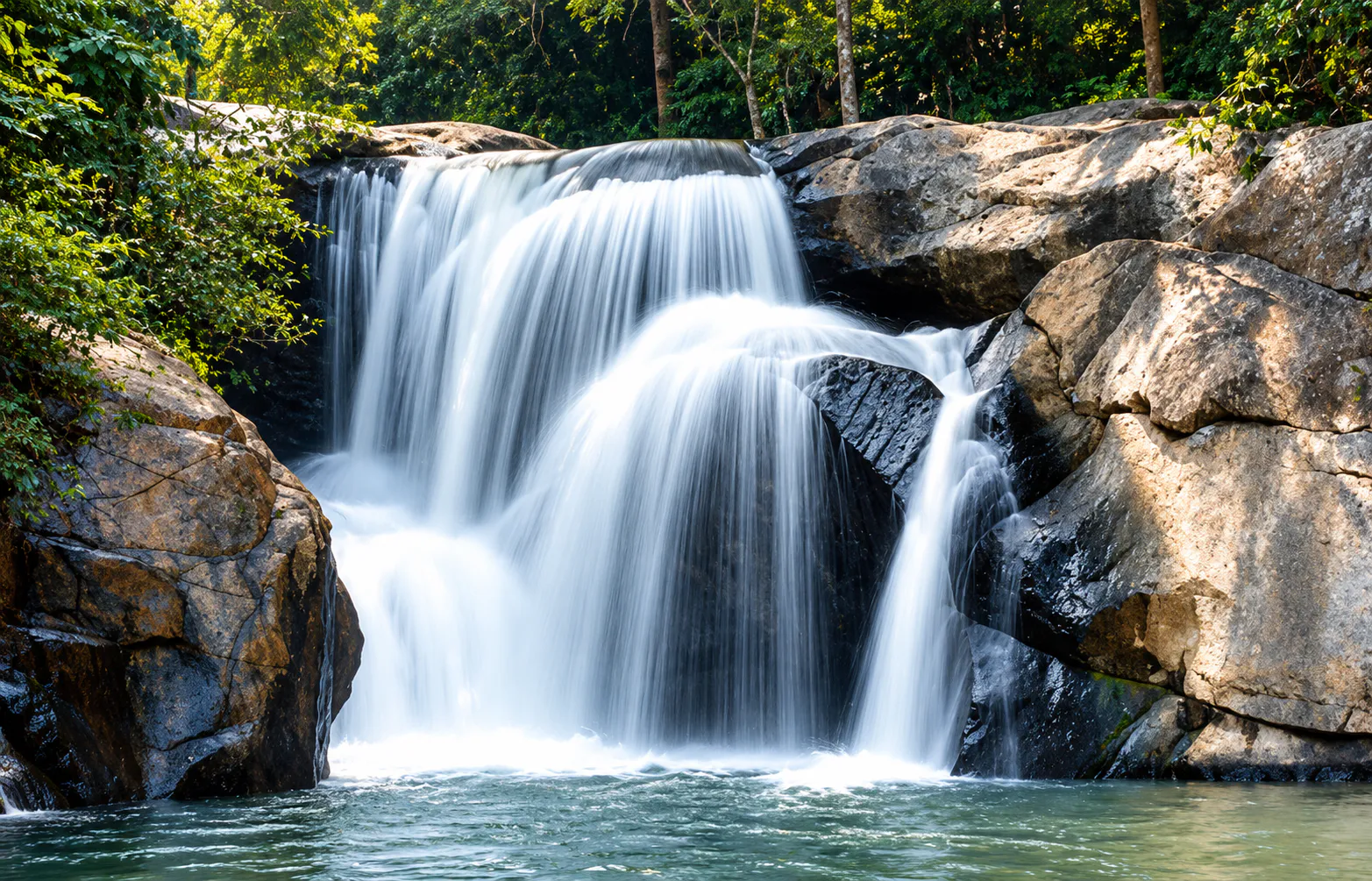
- Forest, waterfalls and the Khao Luang massif in the same province — the natural country around the historic cities.
Location
Find Si Satchanalai Historical Park
Si Satchanalai District, Sukhothai 64190 · beside the Yom River, about 55–60 km north of Sukhothai city