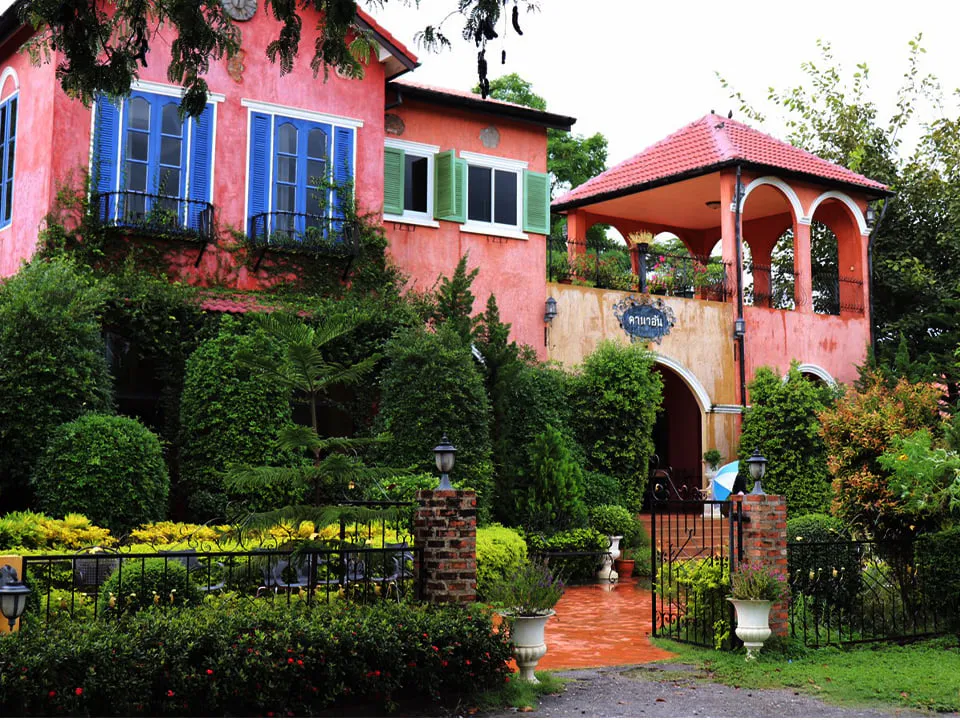
Canaan Winery
A Tuscan-style pavilion among vineyards in Nam Phi, Thong Saen Khan — spiral stairs to the rooftop, grape-leaf miang, and Italian plates in the hills between the iron wells and town.

 ThailandLover
Contact
01
Geography & Climate
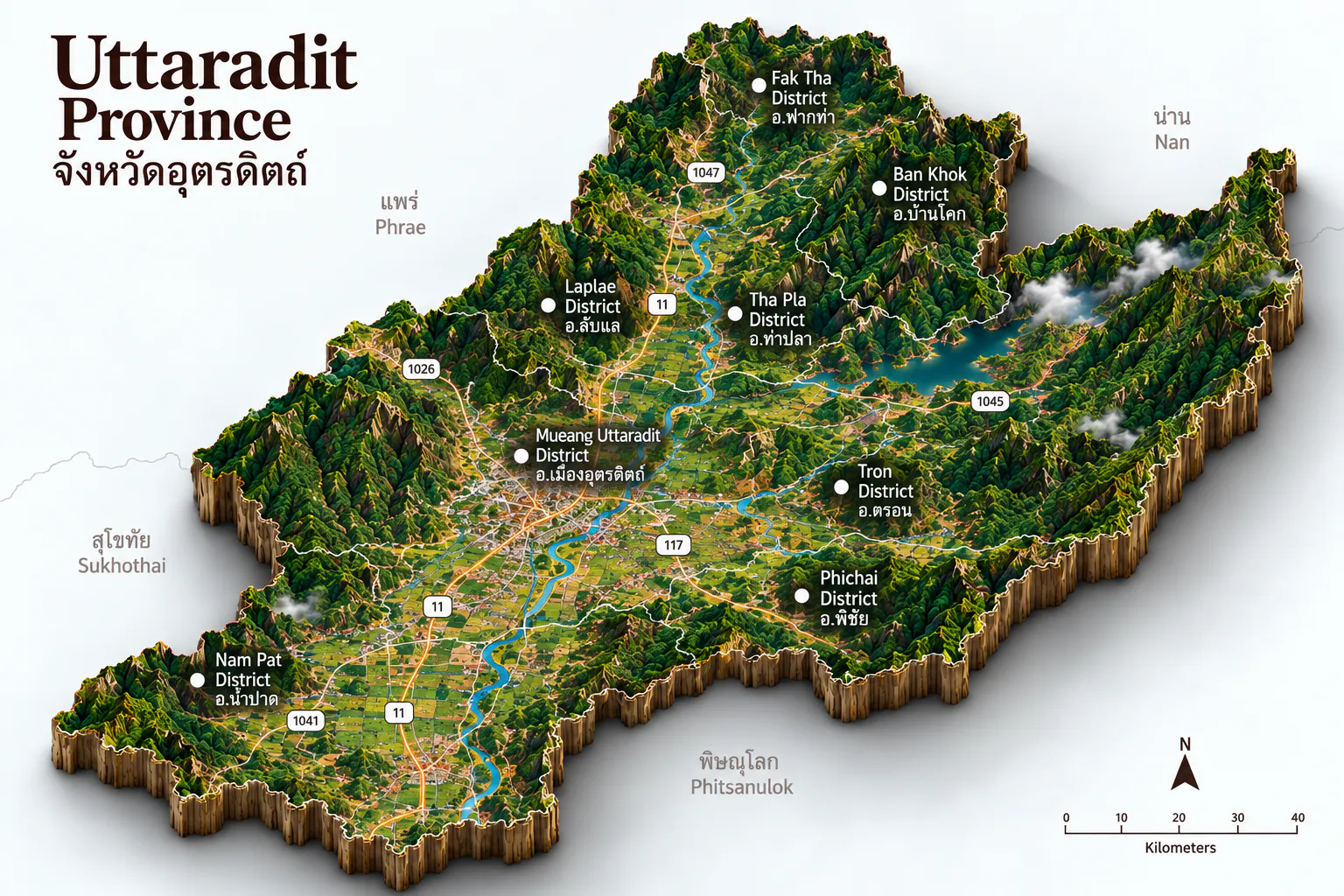
Uttaradit sits in the lower north — about 7,838 square kilometres, some 490 kilometres from Bangkok, and a natural threshold into eastern Lanna. It meets Phrae and Nan to the north, Sukhothai to the west, Phitsanulok to the south and east, and Laos along a long highland frontier. The name itself means a northern landing: this is where Nan River trade once gathered.
The land splits three ways. About a fifth is Nan River floodplain — rice, towns, and orchards around Tron, Phichai, Mueang Uttaradit, Laplae, and Thong Saen Khan. Another fifth is valley and foothill, laced by streams such as the Pat. The rest, some sixty percent, is mountain and highland in the north and east — Phi Pan Nam ridges, the great lake of Sirikit Dam in Tha Pla, and the pine plateau of Phu Soi Dao near 2,100 metres on the Lao border.
The climate follows the northern monsoon. Cool, clearer days settle in from about November to February; March to May is the hot stretch; rains green the orchards and refill the falls from roughly May through October.
Best time: November – February for cool dry air, Phu Soi Dao mist, and easy town days; May – July for Laplae durian season; May – October for lush hills, fuller waterfalls, and quieter roads.
02
History & Heritage
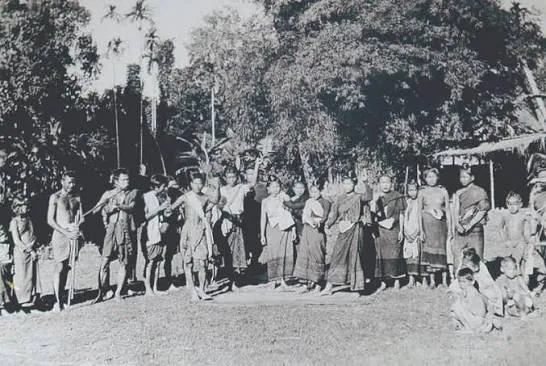
Uttaradit means the port of the north — a name earned on the Nan River long before the modern province. People lived along this valley in prehistoric times: cliff paintings at Khao Ta Phrom and bronze drums recovered by the river show settlement well before the 10th Buddhist century.
In the Sukhothai age several towns rose here — Fang, also called Sawangkhaburi; Thung Yang; and Laplae — names that still appear in stone inscriptions and in the ruins of old walls and chedis. Under Ayutthaya, Phichai became the frontier stronghold of this reach of the Nan. In the Thonburi years of 1772–1773 (B.E. 2315–2316), Phraya Phichai, lord of that city, led his men against Burmese armies until a sword broke in his hand — the hero Uttaradit still calls Phraya Phichai Dap Hak.
The town you walk today grew from Bang Pho Tha It, a riverside trading village where boats from the south met goods coming down from Phrae, Nan, and the far north. In 1887 (B.E. 2430), King Chulalongkorn established it as Mueang Uttaradit, the northern landing, first as a town under Phichai. In 1915 (B.E. 2458) the name of Phichai was changed to Uttaradit, and in 1933 (B.E. 2476) it was raised as Uttaradit Province — the same river bend, now written on the map.
03
Top Attractions
Giant teak, Laplae legends, Sirikit’s lake, and the broken-sword hero — places that shape an Uttaradit journey, listed A to Z.
A Tuscan-style pavilion among vineyards in Nam Phi, Thong Saen Khan — spiral stairs to the rooftop, grape-leaf miang, and Italian plates in the hills between the iron wells and town.

Forest and lake country around Sirikit’s reservoir, shared with Phrae. Climb toward Phu Phaya Pho (1,350 m) or wait for sunset at the Suriyan–Chantra viewpoint, where folded hills ring the water like a painted bowl.

The Sukhothai-inspired arch that welcomes you into Laplae, with the Widow of Laplae statue beside it and the vow “ขอเพียงสัจจะวาจา” at the base. Pause here before the orchards and old-town lanes begin.
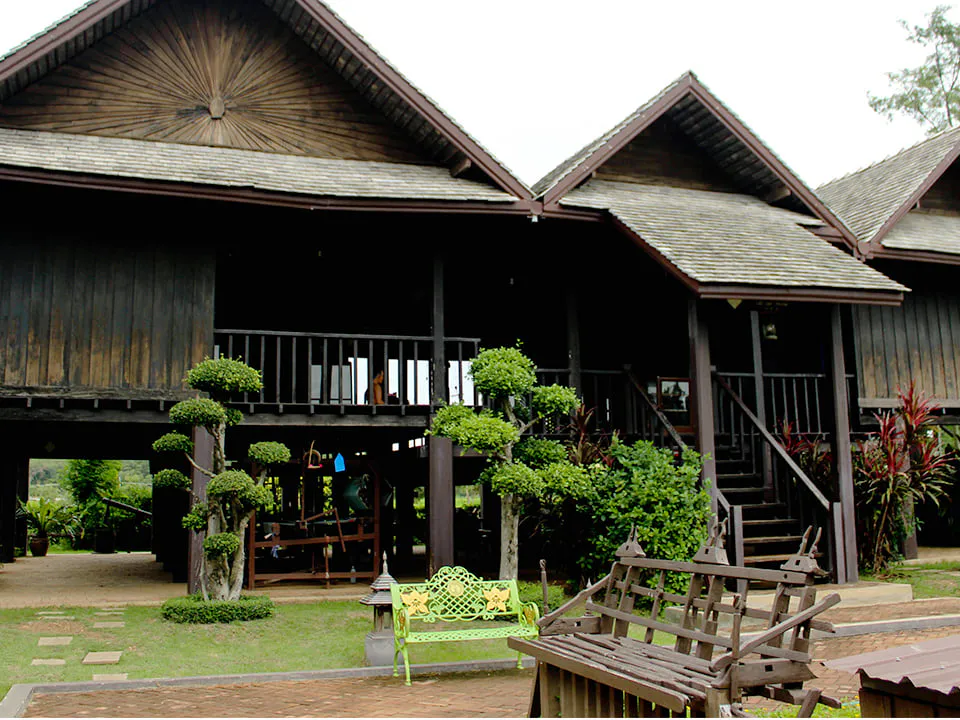
House by house, this small museum retells why Laplae means a town that hid — winding paths, forest, and the old belief that only the meritorious could find it. The mystery thinned when the road arrived; the stories stayed.
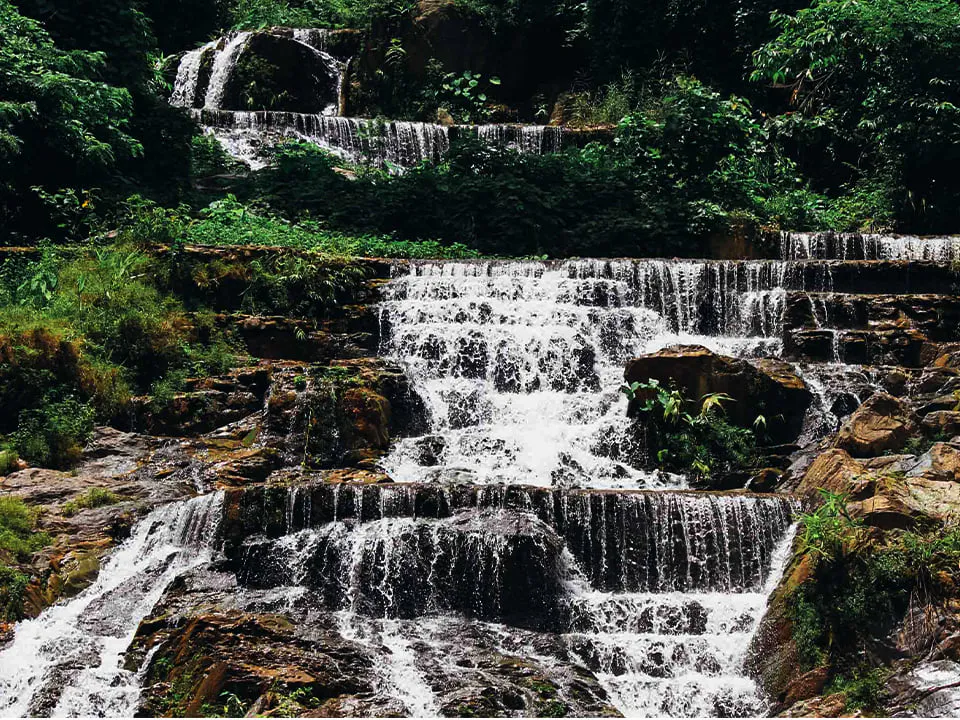
A multi-tier cascade about 20 km from town, shaped along the stream so the water steps down through forest shade. Easy access, salas, and food stalls make it the classic family nature stop near Uttaradit.
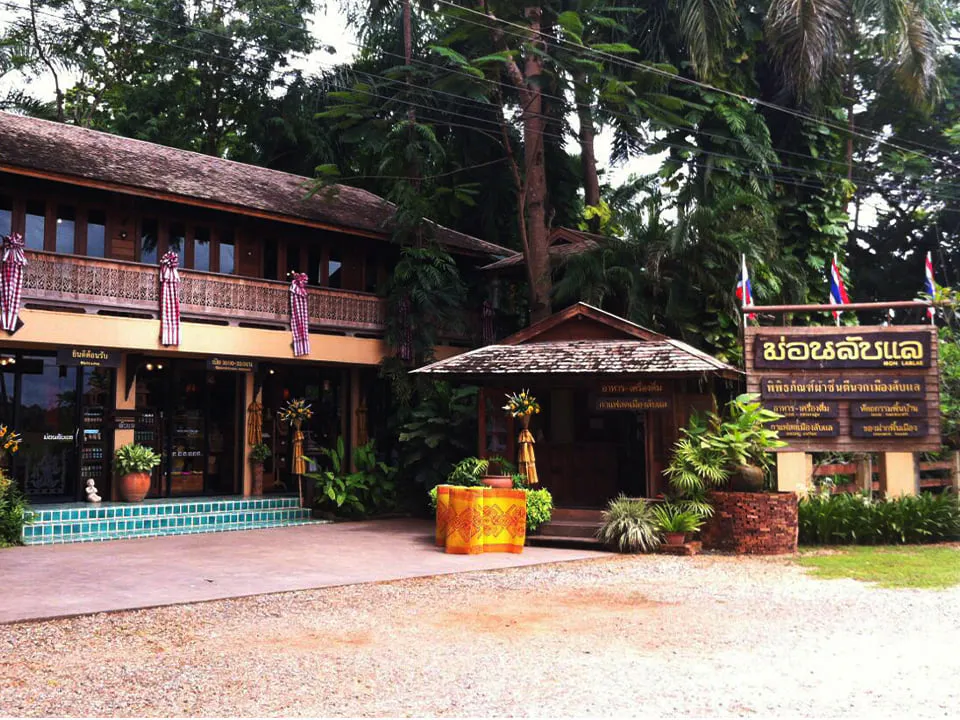
A Lanna-house compound in Laplae — café, kitchen, and a front shop of local crafts and seasonal fruit, staged like a northern mansion garden. Come for shade, souvenirs, and a slower hour between temples.

Natural steel pits in Ban Nam Phi, about 56 km from town, with two royal wells — Bo Phra Saeng and Bo Phra Khan — once reserved for kings’ weapons. Villagers still work Nam Phi iron into amulets, swords, and everyday metal; this is the ore behind Uttaradit’s warrior legend.

A Fine Arts Department historic site from late Sukhothai, tied to King Lithai and later recast in Burmese teak-era form after a 1908 earthquake. Northern lore places Thung Yang as the city of Thao Samon in the Sang Thong tale — come for the chedi, the great viharn, and a quieter layer of the old north.

The bronze hero before the provincial hall, unveiled on 20 February 1969 — Phraya Phichai of the broken sword, who held Phichai against Burmese armies in 1773. Beside him sit the Phraya Phichai museum and the giant Nam Phi iron sword, a civic heart for anyone starting in town.

A pine plateau on the Lao frontier, summit about 2,102 m — one of Thailand’s highest walks. Come in the cool season for sea-of-mist mornings, or in August–September when purple ngone nak blooms across the grassland.
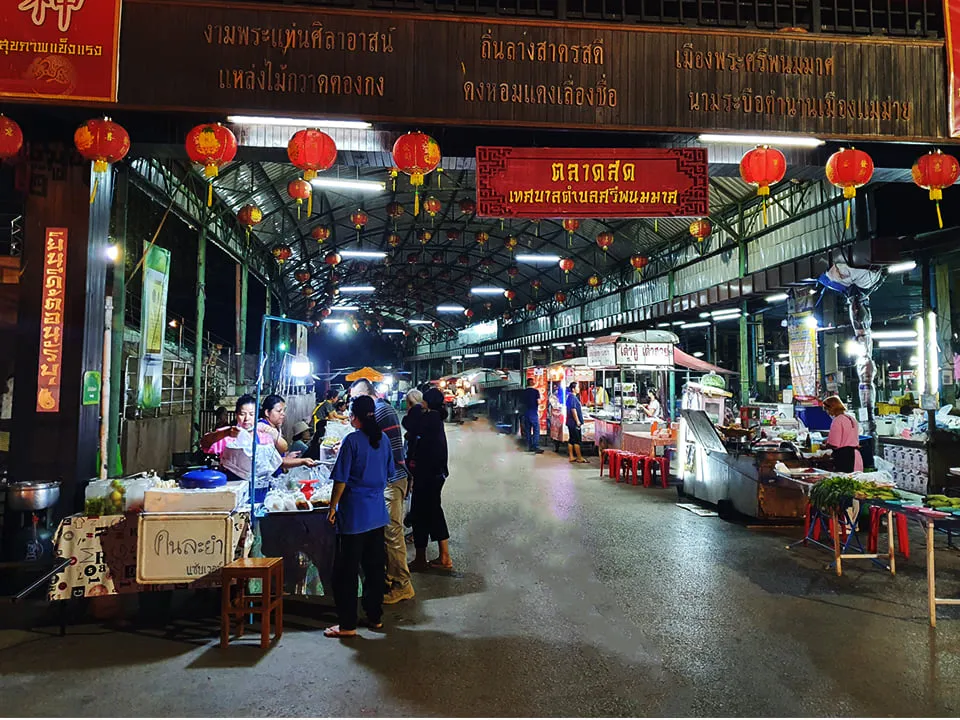
Laplae’s morning market, named for Phra Si Phanommas, with fresh produce, clothes, snacks, and painted façade walls that photograph well in soft light. Walk it early, then continue to the gate and orchards.

Thailand’s largest earth dam, locally still called Tha Pla Dam, holding the Nan as it leaves Nan province. Walk Sumanlai Garden, the Queen’s bridge, and Wang Matcha — a wide water day between the valley towns and the highland parks.

A mixed-deciduous forest whose celebrity is a teak of roughly a thousand years — eight people to encircle, about 9.5 m around and 38.5 m tall, the crown broken by storm, the trunk still sound. Found in the 1920s, it remains the tree travellers come to Uttaradit to stand beside.

A viharn raised from a single teak on a natural mound in Ban Fai Luang, about 9 km from town. Its late-Ayutthaya carved doors — unmatched left and right, perfect when closed — rank among Uttaradit’s three finest temple portals, and one of the two pairs that still survive.

On Khao Tao in Thung Yang, this hill temple holds the Phra Thaen Sila At — the stone seat that is Uttaradit’s great object of faith, spoken of with the same reverence as the Buddha’s Footprint in Saraburi. Climb for blessing, then look back over Laplae.
04
Local Flavours & Food
Uttaradit eats where Lanna, Siam, and the Nan River meet — northern gaeng om and mueang laab, river fish such as pla takok, and Long Laplae durian when the orchards turn. Canal houses, garden cafés, and riverside decks wait in the table below.
Where to Eat
Canal houses, Nan River decks, Laplae durian toasts, and garden cafés — listed A to Z. Hours can change; tap Location for the latest pin.
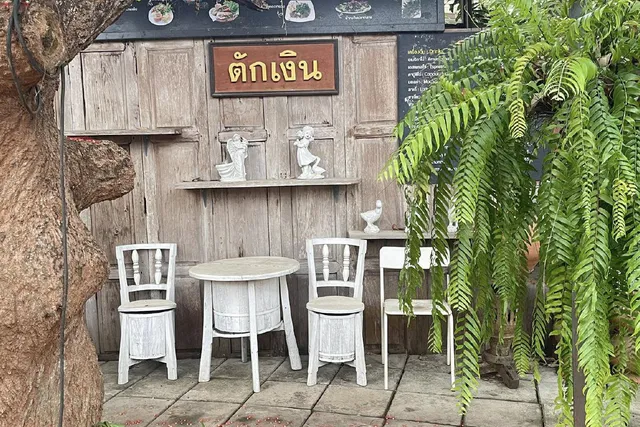
The wooden house locals name first when guests arrive — canal water, shade trees, and a slow northern table in Ban Ko.
Share gaeng om moo, mueang-style pork laab, mixed-mushroom curry, and sadao song krueng; Isaan and southern plates fill the rest of the menu.
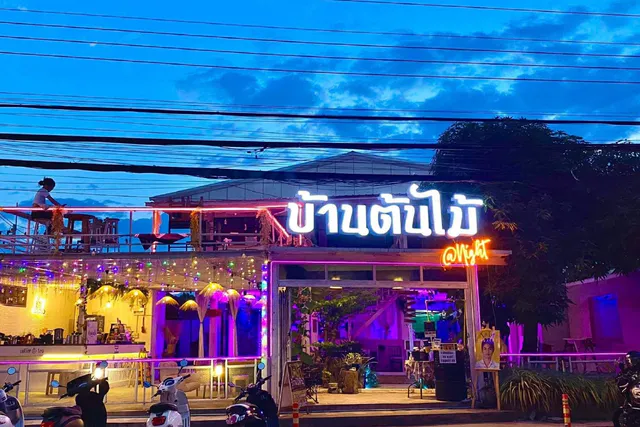
A converted wooden house on Jetsadabodin Road for late tables — live music downstairs, air-con rooms above, and a breezy terrace when the town cools.
Order tom yum goong nam khon, spicy pork-rib naem, lime chicken, and crab fried rice with a cold drink.

A dark container-and-garden room under big trees on the Nan in Pa Sao — more contemporary than most Uttaradit tables, still easy for a long lunch.
Try yum tua plu, green curry in an egg wrap, tom-yum prawn spaghetti, and fish-sauce fried chicken or pork belly.

A white glass-house café in Kho Rum, Phichai — worth the drive south of town for garden light and Thai–fusion plates.
Order sea bass with fish-sauce rice, tonkatsu curry, crispy-chicken green curry, salmon steak, or salted-egg som tam.

A careful Thai kitchen on Phadwari Road in Tha It, known for local river fish and plates that are plated, not piled.
Do not skip gaeng khua hoi khom or nam prik pla takok — and ask for the Laplae-durian chicken massaman when it is in season.
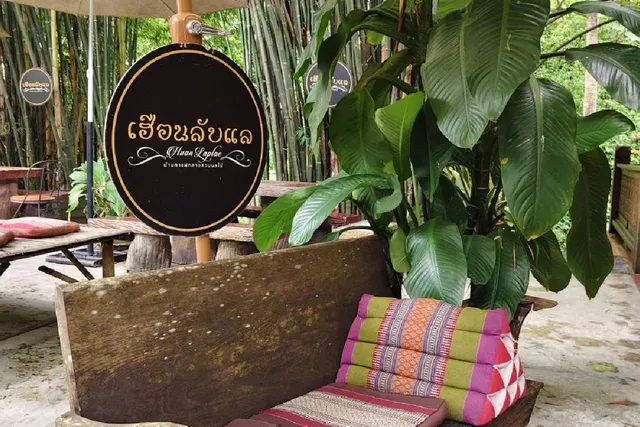
A mountain-and-stream stop about 700 metres before Mae Phun Waterfall — indoor and outdoor rooms, and plenty of photo corners in the trees.
The house move is durian honey toast with coconut ice cream; add a northern khantoke set or a sticky-rice durian smoothie.
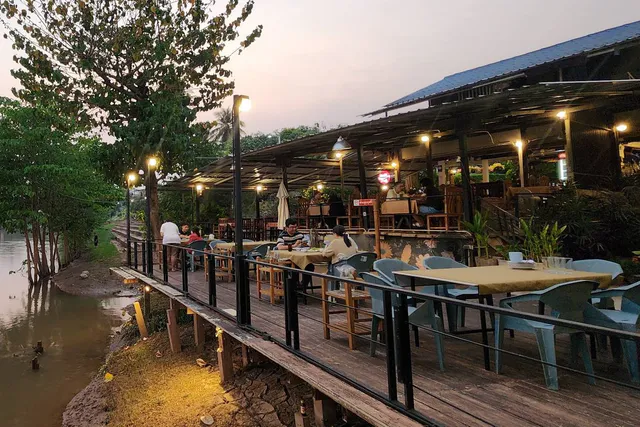
A Nan River terrace on Samran Ruen Road — the deck is at its best at sunset, when the water catches the last light.
Order chu chee pla kod, tom yum pla khang, curry-powder prawns, garlic prawns, and hor mok thalay.
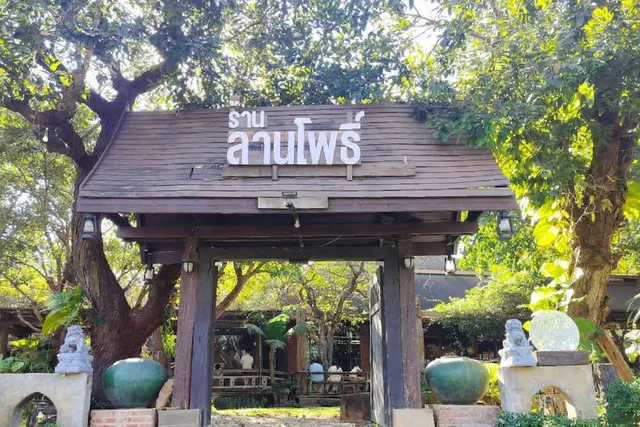
A garden café-restaurant in Thung Yang with a koi pond the children will want to feed — savoury, sweet, and drinks under a green canopy.
Favourites include soy-grilled salmon, German pork knuckle, fish cakes, salted fried chicken wings, then honey toast or ice-cream cake.
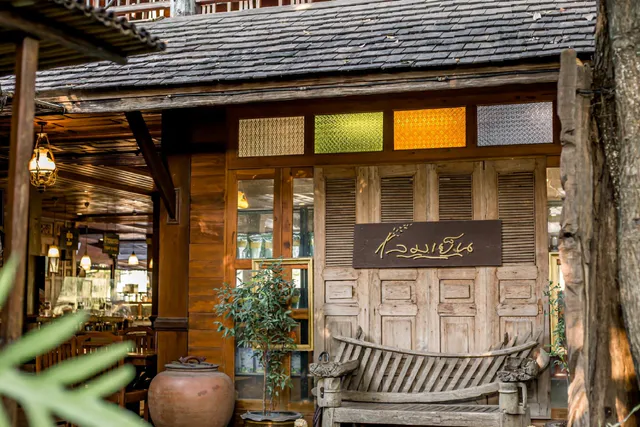
A large Lanna-style wooden house on the Phitsanulok–Den Chai road in Pa Sao — more than twenty years of rice-and-curry stops for locals and through-traffic.
Eat herb-fried fish, khao soi gai, khao man gai, stewed pork knuckle, or tom saep kha moo, then pick up coffee, sweets, and OTOP gifts for the road.
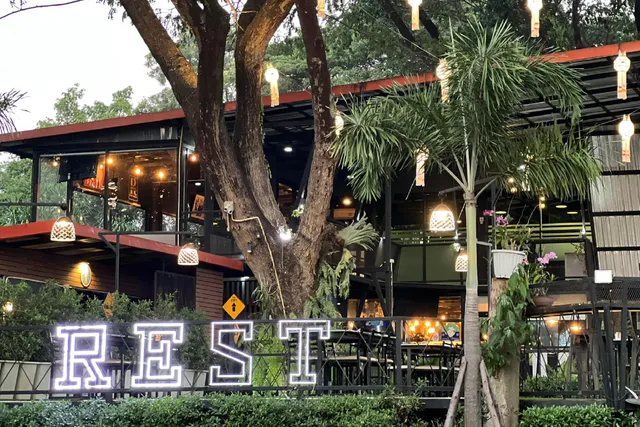
A leafy Nan River table in Pa Sao with a long Thai–international board — skip Wednesday, when the kitchen rests.
Share salmon sashimi, herb-baked mussels, seafood hor mok in young coconut, German pork knuckle, fish-sauce sea bass, and lotus-stem yum with prawns.
05
Souvenirs from Uttaradit
Uttaradit packs the orchard, the kitchen, and the forge into one bag — Long and Lin Laplae durian in season, old-recipe sweets from Laplae, and Nam Phi iron that still carries the broken-sword legend. Fill the cooler first, then leave room for teen-jok cloth and a curved-handle broom you will actually hang at home.
06
Local Culture & Vibe
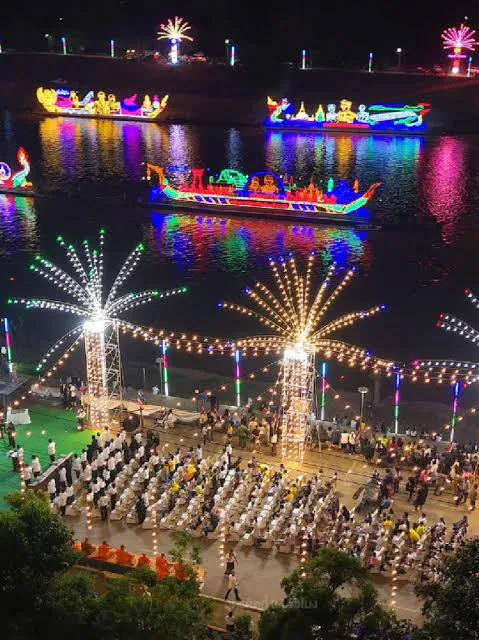
Uttaradit’s year is still a public act of memory. Laplae walks scented water to a first king and wraps a relic chedi in cloth; the city spends January on a hero whose sword broke and still won. Between those rites the orchards write their own festival in langsat and longkong. Come for a ceremony and you meet the province at its most itself: devout, proud, and unhurried.
07
Travel Info & Getting There
How to reach Uttaradit from Bangkok, and how to move around once you arrive.
Uttaradit’s own strip (UTR) has been closed since 1975, so you fly a neighbour and drive in. Phitsanulok (PHS) is the workhorse — frequent Don Mueang hops, then about 1–1.5 hours north on Highway 11. Sukhothai (THS) is closer: Bangkok Airways from Suvarnabhumi in about 1 hour 20 minutes, then roughly an hour to 90 minutes by road. Lampang (LPT) works if you are already on the Lanna circuit.
About 490 kilometres and a 6–7 hour drive in ordinary traffic. Take Highway 32 through Ayutthaya, Ang Thong, Sing Buri, and Chai Nat into Nakhon Sawan, then Highway 11 through Phitsanulok and on into Uttaradit. A second line runs Highway 11 from In Buri toward Tak Fa, then picks up 12/11 at Phitsanulok. Once you are on 11, the province opens along the Nan.
The Northern Line still treats Uttaradit as a real stop — about 485 kilometres from Bangkok, with the station in town. Special Express 7 leaves Krung Thep Aphiwat at 07:30 and is due around 14:22; Express 51 is the overnight sleeper, into Uttaradit around 06:00. Most Chiang Mai trains call here; some local and terminating services also use Sila At, west of the centre. Book a second-class berth ahead in cool season.
Coaches from Bangkok’s Mo Chit 2 take about 6–7 hours over roughly 475 kilometres and roll into Uttaradit Bus Terminal. Nakhonchai Air runs Gold Class day and night (typical VIP hours include morning departures and evening sleepers around 20:30–22:30); Cherdchai Tour, Bussarakham Tour, and Transport Co share the corridor. Daylight seats if you want the rice fields; overnight if you want dawn on the river.
The town is a Nan River bend — walkable between the station, Phraya Phichai’s monument, and the evening market. Songthaews and motorbike taxis cover short hops; Grab is thin, so do not count on it for Laplae. Rent a car or scooter for Nam Phi, Sirikit Dam (about an hour on 1045), Phu Soi Dao, and Ban Khok. Highway 11 is the spine; the orchards and iron wells sit a turn off it.
November to February brings cool, clear days for town, teak, and Phu Soi Dao mist. May to August is Long and Lin Laplae durian; late May into early June is Atthami Bucha at Thung Yang. 7–16 January belongs to Phraya Phichai and the Red Cross fair; September is langsat and longkong. March–April can haze; May–October is greener, quieter, and better for waterfalls after rain.
Continue the Journey